
The Yamaha MT-125 displays a certified power set at the limit of the A1 license, which is 11 kW. This value, recorded in field P.2 of the registration document, conditions everything: insurance, roadside checks, administrative compliance. Modifying this data, even slightly, changes the legal status of the motorcycle. Before adjusting any parameters, it is essential to understand what the term “de-restriction” truly means for this model.
Original restriction on the MT-125: what the engine really undergoes
Unlike A2 motorcycles, whose engines are physically restricted by a removable limiter, the MT-125 is generally not restricted in the traditional sense. Its single-cylinder engine develops its nominal power within the limits imposed by A1 regulations.
Have you noticed that the speedometer seems to plateau well before the red zone? This is not a mechanical restriction to be removed. The electronic management (ECU) calibrates the injection and ignition so that the engine does not exceed the legal threshold. The manufacturer has not added an extra part: it designed the engine to operate within this envelope.
Those who want to de-restrict the MT 125 to know its maximum speed must therefore intervene on the electronics or the transmission, not just remove a component. This distinction is crucial: modifying the ECU changes the vehicle’s reception, with direct administrative and insurance consequences.
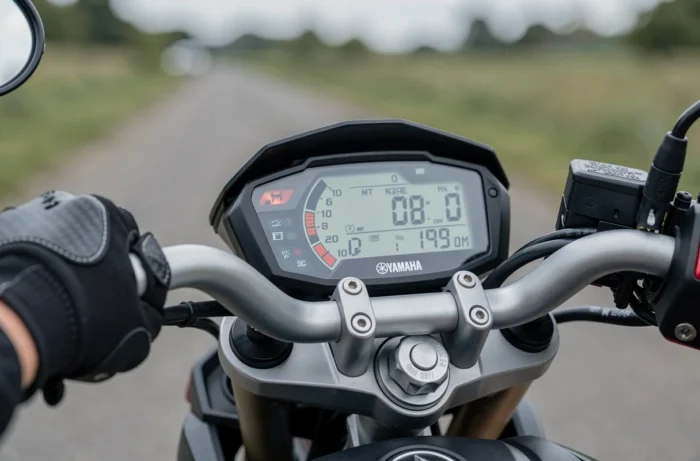
ECU reprogramming and output sprocket: two levers, two logics
Two approaches consistently arise in discussions about the MT-125. They do not act on the same parameters and do not offer the same results.
ECU reprogramming
Reprogramming modifies the injection and ignition maps stored in the ECU. The goal is to unleash a few extra horsepower by allowing the engine to operate beyond its factory calibration.
The actual gain remains modest on a single-cylinder of this displacement. User feedback mentions a few more kilometers per hour at the top end. The engine then operates in a range it was not designed to reach continuously, which puts more strain on the internal components.
Modification of the output sprocket
Changing the output sprocket modifies the gear ratio, not the power. A sprocket with one more tooth lengthens the final ratio: the motorcycle revs up more slowly but can theoretically reach a slightly higher top speed, provided the engine has enough torque to pull this ratio.
In practice, the MT-125 loses acceleration what it gains (sometimes) in maximum speed. On the road, the difference is mainly felt in the pick-up, which becomes softer.
- ECU reprogramming affects engine power but alters the vehicle’s electronic compliance
- Changing the sprocket modifies the transmission behavior without touching the engine itself
- Combining the two results in a gain of a few kilometers per hour at the top end, rarely beyond what forums report (around 130 to 137 km/h on the speedometer according to sources)
- None of these modifications maintain the original compliance recorded on the registration document
Registration document, insurance, and roadside checks: the true cost of de-restriction
The power declared in field P.2 of the registration document is the legal reference. Any modification that exceeds this value renders the motorcycle non-compliant, even if the measured gain on a dynamometer seems negligible.
Why is this point so crucial? Because in the event of a check, law enforcement relies on administrative characteristics. A motorcycle whose behavior or noise does not match its homologation can be immobilized. The penalties are not limited to a fine: they can include the confiscation of the registration certificate.
The insurance must be notified before any power modification. An MT-125 insured in its original configuration but running with an ECU reprogramming or a non-homologated exhaust finds itself in an inaccurate declaration. In the event of a claim, the insurer may contest coverage, even if the modification did not cause the accident.
To regularize a preparation that falls outside the homologation framework, the procedure involves an isolated approval from the DREAL. This process requires a technical file, a dynamometer test, and costs that often exceed the cost of the modification itself.
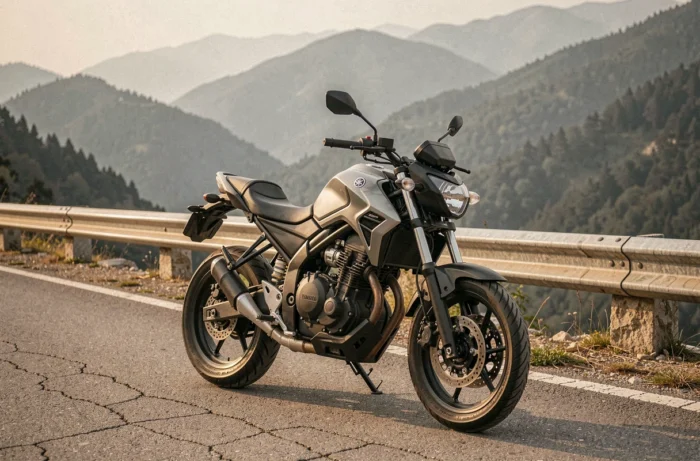
Real maximum speed of the MT-125: untangling speedometer and GPS
The figures circulating on forums should be read with caution. The speedometer systematically overestimates the actual speed, sometimes by several kilometers per hour. A reading of 137 km/h on the speedometer may correspond to a GPS speed that is significantly lower.
In its original configuration, the MT-125 reaches a real speed that several sources place between 120 and 130 km/h on GPS. After the modifications mentioned above (reprogramming, sprocket, free exhaust combined), the gain hovers around a few additional kilometers per hour.
Other factors directly influence the top speed:
- The rider’s weight modifies the load that the engine must move
- The position on the motorcycle changes the aerodynamic drag, a determining parameter beyond 100 km/h
- The condition of the tires and the inflation pressure affect rolling resistance
- Headwinds or tailwinds can vary the top speed by several kilometers per hour
The gain in maximum speed is not a reliable indicator of actual performance. On a daily ride, it is the smoothness at mid-range and the ability to accelerate that determine the pleasure of riding, not the last few kilometers per hour at the end of a straight line.
Before incurring expenses for a modification, check if the expected result justifies the administrative and financial risks. An MT-125 in its original configuration remains a homologated motorcycle, insurable without extra cost and resalable without complication. Each modification moves further away from this simplicity, for a gain in top speed that can be counted on one hand.