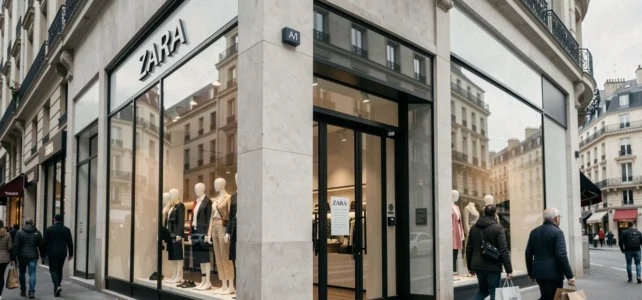
Inditex reports a record net profit of €6.22 billion for its latest fiscal year, yet the closures of Zara stores in France are accelerating. The gap between these two realities is neither a paradox nor a distress signal: it is the result of a methodical real estate arbitration whose structural effects deserve a technical reading.
Sales Area/Revenue Ratio: The Real Indicator Behind Zara Closures
Inditex’s decision-making grid does not rely on the gross profitability of an isolated point of sale. The group thinks in terms of revenue per square meter, combined with the occupancy cost (rent, charges, property tax) relative to the local average basket. When this ratio deteriorates over two consecutive fiscal years, the store enters an exit process.
The closed stores in France share a common profile: modest sizes, located in shopping centers of medium-sized cities where foot traffic has declined. The case of the historic store on rue Alsace-Lorraine in Toulouse, whose closure was confirmed for summer 2026, illustrates this logic. Management explicitly stated that this store “no longer made sense,” without the city itself being abandoned by the brand.
We observe that the detailed analysis of Zara closures and Inditex figures in France confirms this rotation mechanism: the closures do not signal a withdrawal from the French market, but a redeployment towards locations with higher commercial density.
The net balance remains the data to watch. Inditex closes spaces of a few hundred square meters to open or expand flagships whose area far exceeds that of the closed points of sale. The group’s total commercial area does not decline; it concentrates.

Logistical Conversion of Zara Stores: Ship-from-Store and Omnichannel Network
Closures do not systematically result in pure commercial vacancy. Several restructured stores retain a logistical function within the Inditex network. The ship-from-store model, which transforms a point of sale into a shipping hub for online orders, allows for amortizing the real estate presence while reducing delivery times in a given geographical area.
This shift changes the employment profile of the site. In-store sales positions are partially replaced by order preparation and flow management functions. For employees, the transition involves a change in contract or job description, rarely a maintenance of the status quo.
Inditex’s investment in RFID technology and unified stock integration (physical and digital inventory merged in real-time) makes this conversion possible without additional heavy infrastructure. An old Zara store can become an urban micro-warehouse without major renovations, provided that the commercial lease allows it.
Criteria for Converting a Point of Sale into a Logistics Hub
- Sufficient road accessibility for last-mile carriers, which excludes certain pedestrian locations in city centers
- Minimum floor area compatible with storing several hundred references simultaneously
- Proximity to a dense population pool, justifying a delivery time of less than 24 hours in the covered area
Anti Ultra Fast-Fashion Law September 2026: Why Zara Is Not Targeted
The financial penalty that came into effect on September 1, 2026, exclusively targets players classified as ultra fast-fashion: Shein, Temu, AliExpress, and platforms whose volume of references and renewal rate exceed the thresholds defined by the legislator. The penalties, progressive, range from a few dozen cents per item to €19.50 in 2030, capped at 50% of the price excluding tax.
Zara, H&M, Primark, Uniqlo, or Kiabi do not fall within the legal definition. Associating the closures of Zara stores in France with direct regulatory pressure is a misunderstanding. The legislative constraint of 2026 weighs on Asian platforms, not on classic fast fashion.
This regulatory distinction has a direct strategic consequence: by increasing the unit cost of ultra fast-fashion products for the French consumer, the law could mechanically redirect a fraction of demand towards mid-range physical and digital brands. Zara, positioned just above the targeted segment, finds itself in a position of indirect beneficiary.
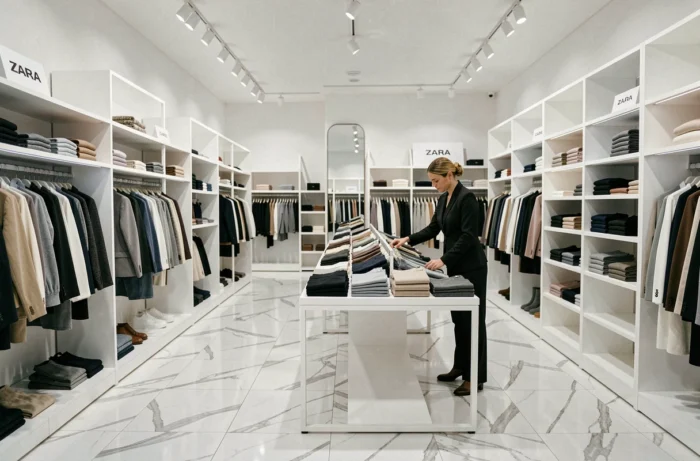
Customer Shift After Zara Closure: Who Captures the Flow in Medium-Sized Cities
When a Zara closes in a medium-sized city, the customer transfer does not occur uniformly. We observe three distinct redirection channels:
- Zara’s own e-commerce, via click and collect at pickup points or home delivery, which captures loyal customers
- Competing brands physically present in the same shopping area (H&M, Mango, Jules depending on the segment), which recover impulse purchases
- Lefties, a brand of the Inditex group positioned at a lower price point, which takes over in certain cities where Zara deems demand insufficient for its main offer
This last point remains under-documented. Lefties operates as a low-cost Inditex retention channel in areas where the average basket no longer justifies a Zara presence. The group thus maintains a commercial foothold without bearing the operating costs of a flagship.
Commercial Vacancy and Impact on Urban Fabric
The closure of a Zara in a medium-sized city center leaves a large commercial space often difficult to re-rent. Landlords face a tight rental market, where few national brands seek this type of square meter outside of metropolitan areas. The vacancy period can extend over several quarters, with cascading effects on the foot traffic of neighboring businesses.
Inditex’s trajectory in France for 2026 can be summarized as a cold arbitration: fewer points of sale, more space per store, and a logistical layer that transforms each remaining store into a hybrid hub. The group’s record financial results confirm that this rationalization works on a global scale, even if it leaves gaps in the local commercial network.