
Marriage in 2026 is built around two axes: a search for authenticity in decoration and ceremony formats, and a regulatory framework that is tightening for both service providers and couples. Natural palettes, micro-weddings, disconnected ceremonies, as well as new prospecting rules and municipal constraints on music are reshaping how this day is prepared.
Municipal Constraints and Ceremony Music: What the Town Hall Can Refuse
Before choosing a theme or color palette, one point needs to be settled in advance: the compatibility of the project with local rules. Municipal decrees regulating noise disturbances apply to town hall exits, outdoor receptions, and outdoor musical entertainment.
Each municipality sets its own hours and allowed decibel levels. A town hall exit with a brass band or amplified sound system can be refused if it has not been declared, or even penalized if it violates a decree. This topic is rarely addressed in inspiration guides, but it conditions the actual flow of the day.
For couples who wish to follow the latest on Esprit Mariage regarding musical scenography, checking with the town hall’s event service remains the first reflex to have, well before selecting the DJ or band.
Wedding Vendor Prospecting and Prior Consent
Since August 11, 2026, French law has replaced the logic of opposition with a prior authorization logic for telemarketing. Wedding service providers (caterers, photographers, wedding planners) who contacted prospects by phone without explicit consent must now have proof of consent kept in their files.
This reform directly impacts the search for vendors. A couple filling out a form at a wedding fair or via a planning app may find themselves solicited by multiple companies. With the new rule, only vendors who have obtained written or digital consent can follow up.
For future newlyweds, the practical consequence is simple: unsolicited follow-ups become illegal. This filters contacts but also reduces the diversity of quotes received spontaneously. It is better to initiate quote requests oneself rather than waiting to be contacted.
Wedding Decoration Trends: Natural Palettes and Organic Minimalism
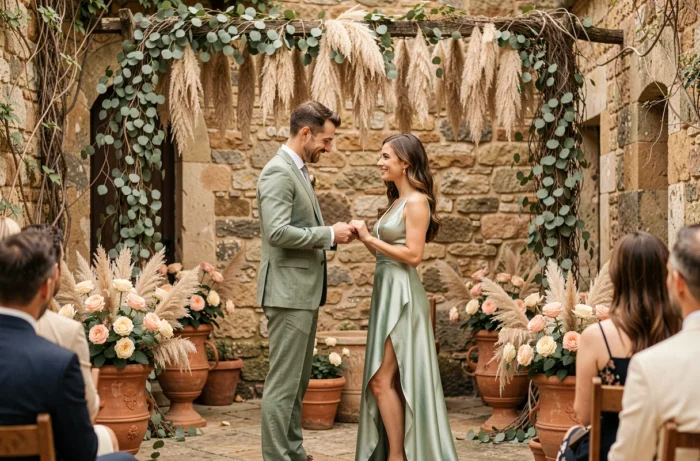
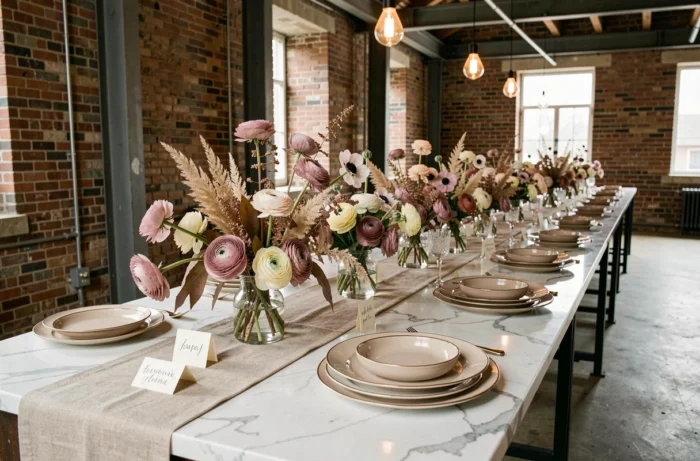
The aesthetic direction this year can be summed up in one principle: raw materials combined with a limited palette. Crumpled linen, untreated wood, artisanal ceramics, and stone make up the tables and reception areas.
The dominant colors remain beige, off-white, and sand, enhanced by a more pronounced shade. Among the most visible choices on decorators’ contracts:
- The sage green, used as an accent on napkins, foliage, and invitations, gradually replacing the eucalyptus green of previous years
- The powdery lilac, often associated with airy floral arrangements and natural wax candles
- The terracotta, still present but now limited to accents (menu, place cards) rather than the main palette
- Silver, which takes the place of gold on cutlery, frames, and signage elements
This shift towards organic minimalism is not just aesthetic. It also reduces the volume of decoration to transport, store, and recycle, simplifying logistics for venues that impose sorting constraints.
Pampas and Pastels: What is Disappearing
Pampas grass, omnipresent for several seasons, is sharply declining in requests. All-pastel without contrast and overloaded floral arches are following the same trajectory. Decorators report that couples now prefer one or two strong plant elements rather than an accumulation.
Disconnected Ceremonies and Micro-Weddings: Formats on the Rise
The trend of unplugged weddings (without phones) is gaining ground. The principle: ask guests to put away their devices during the ceremony, even during the meal. The stated goal is to refocus attention on the moment experienced rather than its capture.
This choice has a technical consequence. Without the dozens of photos and videos taken by guests, the couple relies entirely on professional photographers and videographers. The brief given to these service providers must be more precise, and the number of delivered shots must be higher than in a traditional wedding.
At the same time, micro-weddings with between 30 and 70 guests represent a growing share of celebrations. This format modifies the budget item by item: the cost per guest increases (better caterer, more intimate venue), but the overall envelope often decreases.
GDPR and Wedding Apps
Mobile applications with QR codes for managing invitations, shared photo galleries, or live broadcasts are becoming widespread. The CNIL deliberation No. 2025-024 of March 27, 2025, published in the JORF on April 11, 2025, regulates the collection of personal data via these tools. Couples using a wedding app must ensure that the publisher complies with consent obligations and data deletion after the event.
This point also concerns photographers who offer online galleries with facial recognition or geolocation. Each guest must be able to refuse the collection of their data without being excluded from accessing the photos.
The 2026 edition of weddings thus plays out on two fronts. The first, visible, pertains to choices of style, color, and format. The second, less spectacular, concerns the administrative and digital rules that govern each provider and each tool used on the big day. Checking a municipal decree or the GDPR conditions of an app takes less time than redoing a seating plan and avoids complications that are otherwise much more costly.