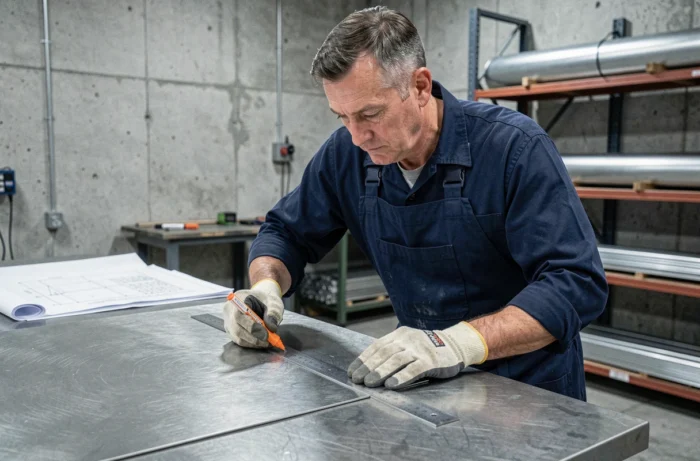
A kitchen splashback to protect, a worktop to dress, a sign to personalize: the custom stainless steel plate meets very different projects. The choice of the right alloy, thickness, and finish determines both durability and visual appeal. Before placing an order, some technical guidelines can help avoid the most common mistakes.
Thickness of a stainless steel plate: the parameter that buyers underestimate
Have you ever noticed that a thin stainless steel sheet warps as soon as it is fixed to an uneven surface? The thickness determines the rigidity of the plate, as well as its ability to withstand thermal shocks near a cooking area.
For a domestic kitchen splashback, a thickness between 1 and 1.5 mm is sufficient in most cases. It remains easy to handle and fix without reinforcements. In contrast, a worktop or professional counter covering requires a thicker sheet, often over 2 mm, to withstand daily mechanical stresses.
The thinner the plate, the more it requires a perfectly flat support. If your wall has flatness defects, a greater thickness will better compensate for irregularities. Before ordering, measure the installation surface and note any offsets with a mason’s rule. You will also find practical tips on Maison Pro to frame your dimensions and tolerances before cutting.
Stainless steel grade 304 or 316: how to choose the right alloy
The grade refers to the chemical composition of the alloy. In simple terms, it determines your plate’s resistance to corrosion, chemicals, and prolonged humidity.
Stainless steel 304L, the versatile standard
Stainless steel 304L (sometimes noted as 1.4307) contains chromium and nickel. It resists corrosion well in domestic and kitchen environments. It is the most common grade for splashbacks, food worktops, and interior decoration.
Stainless steel 304L is suitable for most indoor uses. It withstands grease splashes, common cleaners, and temperature variations related to cooking.
Stainless steel 316L, the choice for aggressive environments
Stainless steel 316L incorporates molybdenum in addition to chromium and nickel. This component enhances its resistance to chlorides, making it suitable for marine environments, covered pools, or laboratories using corrosive products.
Its cost is significantly higher than that of 304L. If your plate remains indoors, away from any saline or chemical environment, switching to 316L represents an unnecessary expense.
Stainless steel surface finish: brushed, mirror, or raw
The finish radically changes the appearance of the plate, as well as its daily maintenance. Three options are most commonly available from custom cutting suppliers.
- Brushed stainless steel: the directional grain reduces the visibility of fingerprints and micro-scratches. It is the most common choice for a kitchen splashback, as it combines a matte aesthetic with easy maintenance.
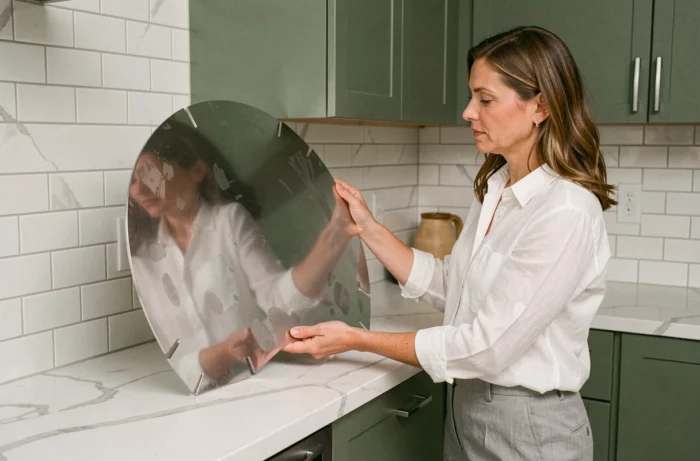
- Polished mirror stainless steel: the reflective surface provides a very bright finish, ideal for a decorative effect in a living room or hall. However, every fingerprint or splash is immediately visible.
- Raw (laminated) stainless steel: the surface has not undergone any polishing treatment. Less aesthetic, it is suitable for technical or industrial uses where appearance is not a priority.
For a splashback behind a cooking plate, brushed remains the best compromise. A quick wipe with a damp sponge is enough to remove splashes, and superficial scratches blend into the grain.
Ordering a stainless steel cut online: pitfalls to check
The French market for custom metal cutting is experiencing a strong rise in online platforms. Instant quotes, millimeter cutting, delivery in mainland France: the process seems simple. But a few points deserve your attention before confirming.
Cutting tolerances and exact dimensions
Each cutting process (laser, water jet, shear) generates a dimensional tolerance. On a laser cut, this tolerance is generally very low, on the order of a few tenths of a millimeter. On a shear, it can be wider.
Check the announced tolerance before ordering. If your plate needs to fit between two walls or in a frame, a margin of one millimeter less is better than one millimeter more.
Deburring and surface protection
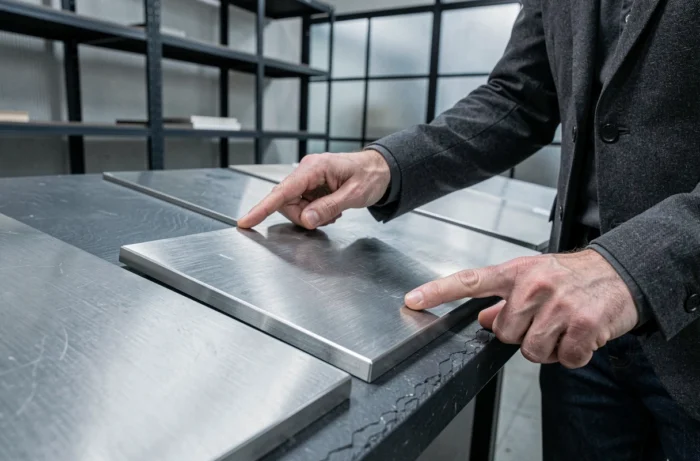
After cutting, the edges of the sheet may have sharp burrs. A good supplier systematically offers deburring. Also, check that the plate is delivered with a peelable protective film on the visible side to avoid scratches during transport and installation.
- Ask if deburring is included or charged as an option.
- Check for the presence of a protective film on the brushed or polished side.
- Inspect the actual dimensions upon receipt, before removing the film.
Customer reviews and supplier reliability
Customer review scores are becoming a key selection criterion for online buyers. Some industry players display several thousand verified reviews. A transparent supplier publishes its actual manufacturing and delivery times, not just an “estimated” time that extends after the order.
Before choosing, compare the announced times, delivery costs for your plate size (large dimensions cost more to transport), and return conditions in case of non-compliance.
Purchasing a custom stainless steel plate relies on three concrete decisions: the grade of alloy suitable for your environment, the thickness consistent with the support and use, and the finish that meets your maintenance constraints. Take your measurements carefully, check the supplier’s tolerances, and do not neglect deburring. A well-prepared order avoids costly returns and adjustments.