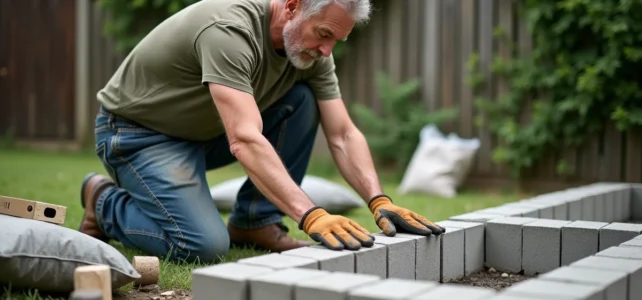
Building an above-ground pool with concrete blocks remains a masonry project in its own right, even if the basin does not sink into the ground. Concrete blocks, a common material on French construction sites, attract self-builders due to their moderate cost and availability.
The current market context reinforces this interest: the boom in mini-pools of ten square meters or less, often made of concrete or masonry structures, is leading more and more individuals to consider a compact, solid basin rather than a tubular or wooden structure.
Hydrostatic pressure and above-ground walls: the structural issue posed by concrete blocks
An inground pool wall works with the soil that contains it. The earth exerts a counter-pressure on the outer face, which partially balances the water pressure inside. In an above-ground configuration, this counter-pressure disappears.
The concrete block wall must then withstand hydrostatic pressure on its own. In a filled basin, pressure increases with depth. At the base of a one-meter-twenty above-ground wall, the load exerted by the water is far from negligible.
The standard hollow concrete block, the one used for a fence wall, was not designed to withstand this type of prolonged lateral stress. Feedback from specialized forums shows cases of cracking or even bulging of the walls when the reinforcement or bracing is insufficient. For everything you need to know about building an above-ground pool with concrete blocks, the issue of structural sizing must take precedence over any aesthetic or budgetary considerations.
Two technical solutions exist to secure the structure:
- The formwork blocks, which create a lost formwork filled with reinforced concrete, offer mechanical resistance far superior to that of standard hollow blocks and are often preferred by professional pool builders.
- The hollow concrete block reinforced by vertical reinforced concrete posts approximately every meter, with a horizontal tie at the top, may be suitable for low above-ground basins but requires rigorous reinforcement calculations.
- The addition of regularly spaced masonry buttresses allows for the lateral pressure to be transferred onto the longest walls of the basin.
Without appropriate vertical and horizontal reinforcement, an above-ground wall made of hollow concrete blocks is at risk of breaking. This point is widely agreed upon in field feedback, even if reinforcement methods vary from one site to another.
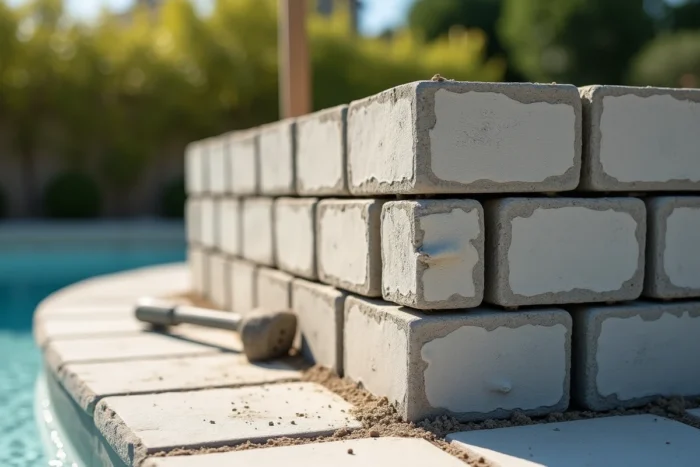
Preliminary declaration and development tax: the administrative framework for an above-ground pool made of concrete blocks
An above-ground pool made of concrete blocks is subject to urban planning obligations. Unlike an inflatable or removable tubular pool, a masonry structure is considered a permanent construction by the authorities, even if it protrudes from the ground.
The process depends on the surface area of the basin. Below ten square meters, a preliminary work declaration is generally not required (outside protected areas). Beyond that, a preliminary declaration is mandatory. After a certain surface threshold, a building permit becomes necessary.
On the taxation side, the 2025-2026 updates on the development tax confirm that pools of less than ten square meters do not trigger this tax, whether they are inground, semi-inground, or above-ground. This exemption applies to both masonry structures and shells, except in protected heritage areas.
Some local urban planning documents (AVAP, heritage sectors) explicitly prohibit above-ground pools visible from public spaces. Recent regulations even go so far as to ban tubular or self-supporting above-ground pools in these areas.
A concrete block pool, due to its permanence and visibility, may therefore face rejection even if its surface remains modest. Consulting the local urban plan at the town hall before purchasing materials remains the first concrete step of the project.
Concrete slab and waterproofing: the foundations of a masonry above-ground basin
The slab (the base slab) constitutes the foundation of the entire basin. For an above-ground pool made of concrete blocks, it must be sufficiently thick and reinforced to support the weight of the water and anchor the walls.
Preparing the ground involves stripping the topsoil, precise leveling, and laying a bed of compacted gravel. The reinforcement of the slab connects to the vertical reinforcements that will rise within the concrete blocks, ensuring mechanical linkage between the ground and the walls.
Waterproofing is the most critical technical aspect after the structure. Concrete blocks are not waterproof by nature. Two dominant approaches exist:
- Installing a reinforced liner or PVC membrane on all interior walls and the bottom, the most common solution in self-construction.
- Applying a waterproof coating (such as a water-repellent coating or polyurethane resin) directly onto the coated concrete block, a more technical method that requires impeccable surface preparation.
- The combination of both (regularization coating followed by a liner) offers double security but increases the budget.
The choice between these options depends on the desired finish and budget. A liner can be replaced, while a waterproof coating can be repaired as needed. Field feedback varies on the comparative durability of the two solutions in above-ground contexts, where thermal variations put more stress on exposed walls.
Realistic budget for an above-ground pool made of concrete blocks: items to balance
Concrete blocks remain one of the cheapest materials per square meter for building a basin. This saving on raw materials should not overshadow the cost of other items, often underestimated in self-construction.
The reinforced concrete slab, wall reinforcement, finishing coating, waterproofing system (liner or coating), filtration, sealing parts (skimmer, return jets, bottom drain), and electrical connections constitute the main items. In a small above-ground basin, filtration and waterproofing often represent a larger share of the budget than the masonry itself.
The financial gain compared to a prefabricated concrete pool kit or a polyester shell mainly comes from labor, as self-construction eliminates this cost. However, sizing or waterproofing errors can lead to costly corrections. A basin that leaks or has a wall that cracks after the first winter quickly negates the initial savings.
The segment of masonry mini-pools of less than ten square meters, which has been growing rapidly since 2024, benefits from a dual advantage: a contained materials budget and an exemption from development tax. These small basins made of concrete blocks or formwork blocks are now offered with the same equipment as a large pool (heating, counter-current swimming, automatic treatment), allowing for the calibration of equipment levels according to the available budget without sacrificing the structural integrity.

The success of an above-ground pool made of concrete blocks relies on three technical balances: the choice between reinforced hollow blocks and formwork blocks, the type of waterproofing selected, and the sizing of the reinforcement based on the above-ground height.
Neglecting any of these three points turns an economical project into a site that needs to be redone. Consulting the local urban plan, validating the reinforcement plan, and allowing for a budget margin for waterproofing remain the decisions that determine the long-term viability of the basin.