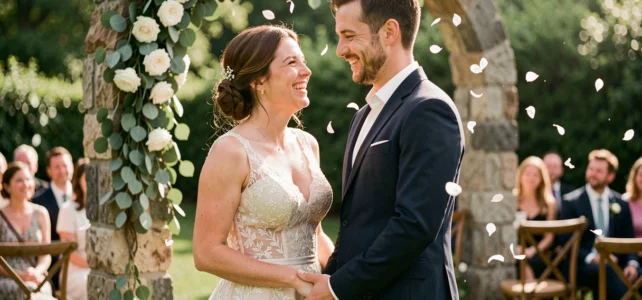
Organizing a personalized wedding means first accepting that no ready-made template will tell your story. Couples planning their ceremony in 2026 are moving away from fixed themes to create a day that reflects them, with concrete choices about the venue, the pace of the celebration, and the details that truly matter.
Couple’s Scenography: Replacing the Theme with a Narrative Thread
Have you ever flipped through a “bohemian” or “rustic” wedding catalog and felt that nothing resembled you? That’s a sign that a codified theme is no longer enough. Wedding planners are noticing that in 2026, couples prefer a personal narrative over a decorative theme. The idea is to draw from your shared memories, a foundational trip, or a shared passion, and derive a color palette, materials, and a visual vocabulary from it.
A couple who met in a bookstore might incorporate excerpts from novels into their stationery, choose a venue with a library, or suggest a book signed by guests instead of a traditional guestbook. The narrative thread isn’t decreed on Pinterest: it is built by listing together the foundational moments of your relationship.
To advance this reflection, and they got married offers resources that help structure this approach, from the first draft to the choice of service providers.
This preliminary work simplifies all decisions afterward. When the thread is clear, the choice of decoration, menu, and music follows naturally, without hesitating between dozens of disconnected options.
Customizable Reception Venue: The Decisive Criterion for the Wedding
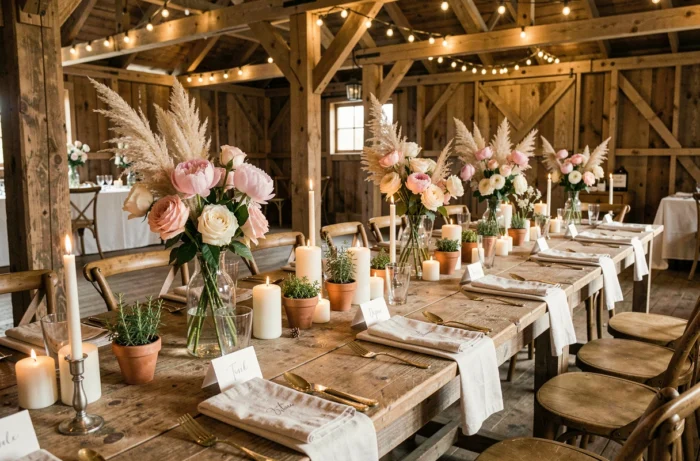
The venue influences the atmosphere far more than any decorative element. In 2026, the strong trend focuses on modular exceptional spaces: former abbeys, contemporary estates, rehabilitated industrial buildings. Their common point is functioning as a blank canvas that each couple transforms in their own way.
What a Modular Venue Changes in Practice
A transformable space allows the day to be divided into distinct sequences. The civil ceremony takes place in a walled garden, the cocktail moves to an inner courtyard, and the dinner takes over a vaulted room. Each moment has its own ambiance without guests needing to drive.
Before signing, check three practical points:
- The possibility of bringing in your own caterer, as some venues impose an exclusive provider that limits your menu and budget choices.
- Noise constraints: a venue in a residential area often requires music to stop before midnight, which radically changes the flow of the evening.
- On-site or nearby accommodation, to avoid late-night travel for your guests and extend the celebration without logistical stress.
Visiting the venue at the same time as your planned reception gives a realistic idea of the light, ambient noise, and traffic. A beautiful room at noon can become dark and cold by eight o’clock.
Wedding Budget: Prioritize Instead of Wanting Everything
Personalization does not mean spending more. It requires focusing the budget on two or three priority areas and making modest choices elsewhere. A couple passionate about gastronomy will invest heavily in catering and choose minimalist floral decoration. Another will prioritize a renowned photographer and serve a convivial buffet rather than a seated dinner.
Identifying Areas to Compromise
Start by listing your three favorite moments from the weddings you’ve attended. These are your budget priorities. Everything else can be reduced or eliminated without diminishing the day’s emotional impact.
The classic pitfall: distributing the budget evenly across all areas. As a result, each provider receives an average amount that does not allow for any remarkable service. It’s better to have an excellent caterer and simple invitations than five average providers lined up.
For the guest list, each added person impacts the caterer, drinks, furniture rental, and sometimes accommodation. Reducing the list by ten guests frees up a significant amount that you can reinvest in an area that matters to you.
Civil Ceremony and Customized Moments
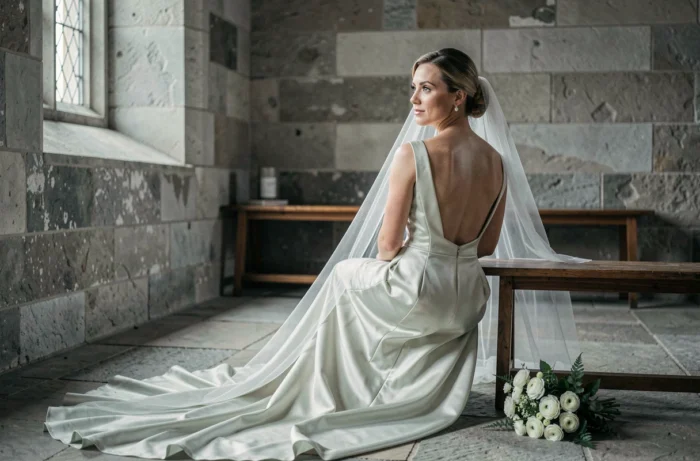
The civil ceremony has become the most personal space of a wedding. Unlike a religious ceremony, which follows a set structure, it can be freely composed: texts written by the couple, contributions from loved ones, and jointly chosen symbolic rituals.
A common mistake is to try to do too much. A forty-five-minute ceremony with eight speakers exhausts the guests’ attention. Three or four key moments are enough to create lasting emotion. A personal text from the couple, a reading by a loved one, a shared ritual (planting, sand, candle), and a musical exit create an effective structure.
Organic Minimalism: An Aesthetic That Serves Personalization
In terms of ceremony decoration, the 2026 trend of organic minimalism works well with a personalized approach. Raw materials, weathered wood, natural textiles: these elements create an elegant setting without overshadowing the emotional content. The less ostentatious decoration there is, the more space the words and gestures occupy.
This aesthetic choice also reduces costs and logistics. A few seasonal floral arrangements, candles, and draped fabric over a simple arch: elegance comes from coherence, not accumulation.
Wedding Service Providers: Choose Partners, Not Suppliers
A provider who understands your narrative thread will produce a result that is coherent with the entire day. During the first meeting, tell your story before discussing logistics. A photographer who captures your couple dynamic will take natural images. A caterer who knows your culinary memories will propose a meaningful menu.
Two selection criteria deserve special attention:
- The ability to listen during the first exchange: a provider who immediately offers their standard package without asking questions about your project will likely lack flexibility on the big day.
- The portfolio or references in a style similar to yours: ask to see work from weddings comparable in size and ambiance, not just the most spectacular ones.
A personalized wedding relies on the clarity of your priorities and the quality of your choices, not on the volume of accumulated details. The most memorable days are often those where each element, from the venue to the last song, tells the same story.