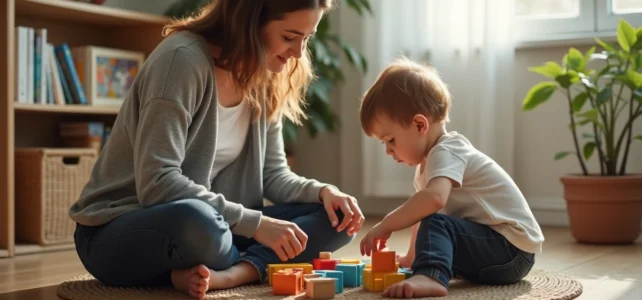
A child who spills his bowl of cereal, another who refuses to put on his shoes before school: it is in these micro-moments of daily life that a large part of children’s awakening and education takes place. Not in a structured program bought online, but in the parents’ ability to turn mundane situations into learning opportunities.
Micro-sequences of awakening: structuring learning in less than twenty minutes
It is often imagined that supporting a child’s development requires long, prepared workshops. In practice, feedback from families converges towards a much shorter format: activities of ten to twenty minutes, repeated daily, focused on a single objective.
Specifically, this results in a color sorting sequence with socks while putting away laundry, or five minutes of gesture songs before bath time. Daily repetition anchors learning better than a long weekly session. The child knows what to expect, and this predictability makes him more available.
To find ideas suitable for each age group, dedicated resources for children on Maman Chic offer concrete suggestions categorized by theme. The principle remains the same: a clear objective (language, motor skills, autonomy), a short time frame, and regularity throughout the week.
Adapting the sequence to the child’s state
A micro-sequence only works if the child is receptive. After preschool, fatigue makes cognitive activities counterproductive. We then favor sensory games or free manipulation (playdough, water transfer) that engage fine motor skills without requiring verbal concentration.
In the morning, on the contrary, cognitive availability is often better. This is the right time for language games, riddles, or choice books. Aligning the awakening activity with the child’s biological rhythm radically changes his engagement.

Sensory environment at home: light, noise, and child’s availability
There is much talk about educational activities, but rarely about what happens beforehand: the sensory state in which the child approaches their day. Recent publications highlight an underestimated lever by parents, that of the immediate environment (light, noise level, smells).
Waking up with progressive light rather than a ceiling light turned on all at once reduces the stress of the wake-sleep transition. Maintaining a moderate noise level in living spaces in the evening facilitates falling asleep, and thus the quality of sleep, which directly conditions the learning capacity of the next day.
Arranging without investing
No need for expensive materials. We can act on three simple axes:
- Reduce visual stimuli in the bedroom: remove toys from the line of sight at bedtime, keeping only one or two familiar objects that serve as reference points.
- Create a gentle sound signal associated with transitions (a short melody before meals, a calm sound before bath time) so that the child anticipates the change of activity without resistance.
- Use stable scents: the same lavender essential oil on the pillow every night, for example, establishes a sensory conditioning that shortens the time it takes to fall asleep.
A stable sensory environment reduces conflicts related to transitions (meals, bedtime, departure for school). It is a foundational work, not spectacular, but families who implement it notice a clear difference within a few weeks.
Active listening in the family: a short ritual that changes educational exchanges
When we talk about gentle education, we often think of conflict management. The listening aspect remains vague. Recent practices formalize what could be called an active listening ritual at home, distinct from the simple “how was your day.”
The principle: dedicate individual time of five to ten minutes per week to each child, without interruption, without screens, without siblings. The adult listens, reformulates what the child says, and does not propose an immediate solution. Reformulating without correcting teaches the child that their emotions are legitimate.
Concrete implementation of listening time
Choose a fixed time slot (Wednesday after snack, Sunday morning). The child knows that this moment belongs to them. Some parents use a talking object: the one holding the object speaks, the other listens. This simple framework works from preschool onwards.
Feedback varies on this point: some children take ownership of the ritual within a few days, while others take several weeks to find their place. The idea is not to force speech, but to guarantee an available space. The regularity of the framework matters more than the duration of the exchange.
Everyday educational games: transforming routines into awakening activities
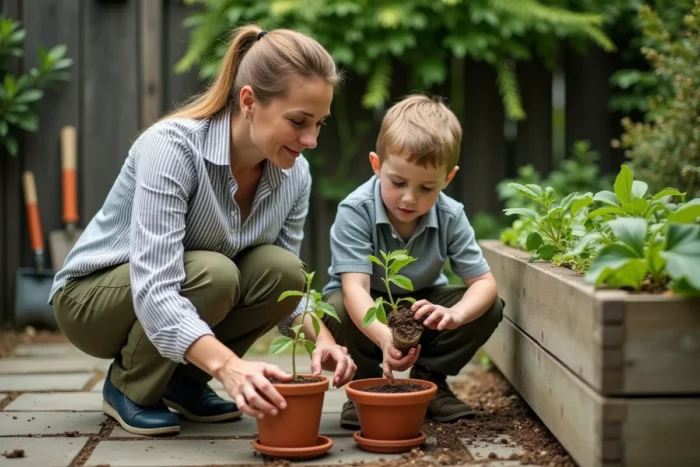
The best educational games are not in a box. They are found in daily gestures, provided they are approached with minimal educational intent.
- Cooking: weighing ingredients develops the concept of quantity and fine motor skills. Asking a preschool child to count the spoons of flour introduces counting without a worksheet.
- Shopping: reading labels together works on letter and number recognition. Comparing the prices of two similar products initiates logical reasoning.
- Cleaning up: sorting toys by category (vehicles, animals, building blocks) trains classification, a basic cognitive skill.
- Walking: naming trees, counting red cars, spotting signs, everything becomes a support for language and observation.
Every household routine can become an awakening activity if we integrate a simple instruction appropriate to the age. The advantage: the child learns in a real context, which promotes the transfer of skills to school and social life.
Supporting children’s awakening does not rely on a rigid program. Parents who achieve the most tangible results are those who adjust their approach to the child’s signals, keep sequences short, and invest in the sensory environment as much as in the activities themselves. A predictable framework, simple rituals, and genuine attention are enough to support daily development.