
A pack of cigarettes purchased in Switzerland costs significantly more than in France, and the gap does not narrow in 2026. For a French smoker considering a trip across the border, the surprise can be unpleasant: the price of tobacco in Switzerland often exceeds that practiced in France, despite a differently structured taxation.
Understanding what makes up this price, what has changed since 2024, and what the law actually allows to bring back helps avoid miscalculations.
Swiss Federal Tobacco Law: What Has Changed Since October 2024
Most articles compare prices between neighboring countries without explaining why Switzerland applies its own rules. The mechanism is simple: since October 1, 2024, a new federal law on tobacco products and electronic cigarettes regulates the Swiss market more strictly.
Specifically, advertising for tobacco is prohibited in public spaces (billboards, transportation, cinema, sports fields). Manufacturers can no longer rely on visibility to gain market share. Competition then shifts to the only remaining lever: price. But since Swiss taxation on tobacco remains high, this pressure does not lower prices.
Another direct change: the sale of tobacco and electronic cigarettes is prohibited for those under 18 across the entire federal territory. This tightening of the market to an exclusively adult audience reduces potential sales volumes, which may encourage manufacturers to maintain high unit margins.
If you are looking for a detailed comparison of tobacco prices in Switzerland 2026 and the real limits of duty-free, these two parameters (advertising ban and age restriction) partly explain why prices remain high despite the absence of a drastic tax increase comparable to that observed in France.
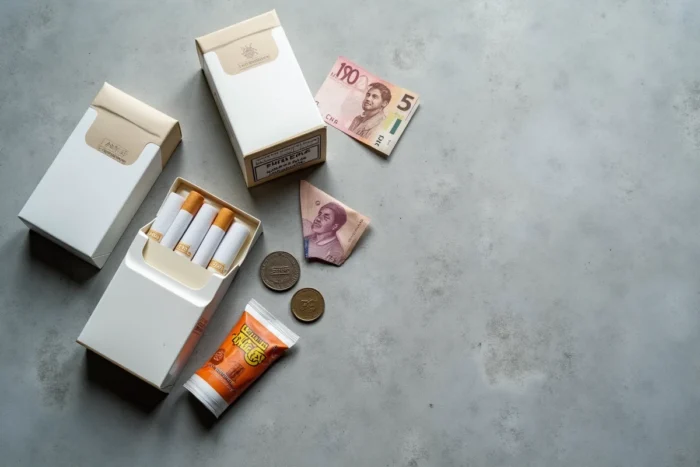
Price Difference of Tobacco Between Switzerland and France in 2026
Have you ever compared the price of the same pack on both sides of the border? In France, some packs of cigarettes now reach 14 euros after successive increases in January, February, and March 2026. More than 500 references saw their prices increase by 10 to 80 cents just on March 1.
In Switzerland, the price of a pack of common brand cigarettes is above this French threshold, converted into euros. The gap varies depending on the brands and the Swiss franc/euro exchange rate, but buying tobacco in Switzerland does not represent a saving for a French resident.
The logic of cross-border purchasing works the other way around: it is Swiss residents who sometimes cross the border to buy their tobacco in France, Germany, or Luxembourg, where prices remain lower. For a French person, the detour through Switzerland has no financial interest for tobacco.
The Exchange Rate Trap
A pack displayed at a given price in Swiss francs may seem reasonable if one forgets the conversion. The Swiss franc remains a strong currency against the euro. A difference of a few cents in Swiss francs often translates into a notable additional cost in euros.
Check the daily rate before any purchase. Swiss tobacco shops do not always accept euros, and when they do, the rate applied is rarely favorable to the customer.
Alternative Products to Cigarettes: Swiss Taxation in Motion
The federal law of 2024 does not only concern traditional cigarettes. It also encompasses electronic cigarettes and nicotine pouches, two categories of products whose taxation is evolving.
- Nicotine pouches (such as snus or tobacco-free equivalents) have rapidly developed in Switzerland. Their taxation remains lighter than that of traditional cigarettes for now, and the regulatory trend is moving towards gradual tightening.
- Liquids for electronic cigarettes containing nicotine fall under the scope of the law. Their advertising regulation is identical to that of traditional tobacco, and their sale to minors is prohibited.
- Heated tobacco products (such as IQOS or equivalents) follow the same regulatory trajectory. Their price in Switzerland remains higher than in France for comparable products.
For a buyer accustomed to French prices, none of these categories represent a good deal in Switzerland. Swiss taxation on these products is not fixed, and the trend is towards a gradual alignment with the taxation of combustible tobacco.

Allowed Quantities and Customs Checks at the Swiss Border
Bringing tobacco from Switzerland to France follows specific rules. Since Switzerland is not a member of the European Union, the customs allowances are those applicable to third countries, which are much more restrictive than those between EU member states.
- The quantity of cigarettes allowed duty-free for a traveler entering France from Switzerland is significantly lower than that applicable for a return from Germany or Luxembourg.
- Rolling tobacco, cigarillos, and cigars each have their own duty-free thresholds.
- Any excess is subject to confiscation of the surplus and a customs fine, calculated on the value of the products and the duties evaded.
Checks at the Franco-Swiss border crossings (Geneva, Basel) are frequent, including on secondary routes. French customs regularly target vehicles returning from Switzerland, and tobacco is among the goods systematically checked.
Duty-Free at the Airport: A False Good Idea
Duty-free shops at Swiss airports offer tobacco at tax-free prices. But the real gain is limited by the customs allowances upon arrival in France. Buying three cartons in duty-free is pointless if you can only declare a fraction without paying duties.
The calculation should be done before checking out, not after the customs check. The difference between the Swiss tax-free price and the French inclusive price, once customs duties are applied to the surplus, often turns out to be negligible.
Tobacco in Switzerland remains an expensive product, regulated by recent legislation that neither favors price reductions nor advantageous cross-border purchases for French residents. Before slipping a pack into your suitcase in Geneva or Zurich, the most useful reflex is to check the customs allowances and the daily exchange rate.