
When an elderly relative needs a transfusion of red blood cell concentrates (RBC), the first concern often revolves around what might happen during or after the blood bag. The body of a person over 75 does not react the same way as that of a younger individual. Understanding the side effects of a transfusion in older adults allows for better anticipation of warning signs and improved daily support for the patient.
Post-transfusion volume overload: the most common risk after 75
The heart of an elderly person poorly tolerates a rapid increase in volume. This is known as volume overload, abbreviated as TACO (Transfusion-Associated Circulatory Overload). In practical terms, the transfused blood increases the circulating volume faster than the heart can manage.
Imagine a garden hose connected to a faucet at full power: if the hose is old and rigid, the pressure rises dangerously. In an elderly patient whose arteries are less flexible and whose heart muscle is weakened, the mechanism is similar.
Signs to watch for include: sudden shortness of breath, cough, rising blood pressure, or even pulmonary edema. To better understand the side effects of a transfusion in older adults, it is important to note that TACO represents the most feared complication in this age group, far more than allergic reactions.
The infusion rate must be tailored to the patient, not to the standard protocol. The recommendations from ARS Centre-Val de Loire for those over 70 emphasize a slow rate and close monitoring of respiratory rate and blood pressure, especially during the first few minutes.
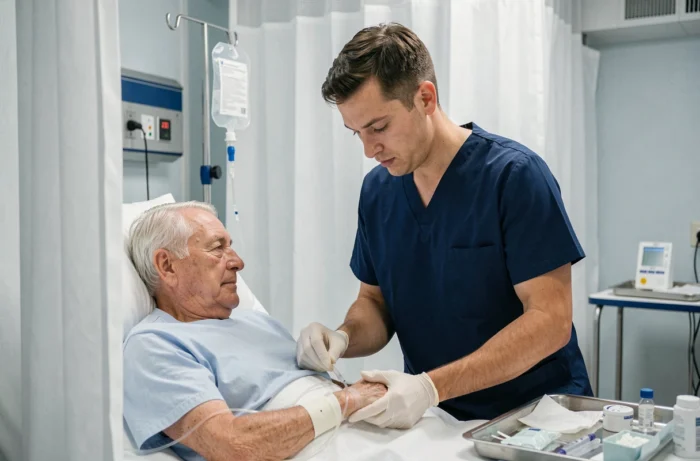
Restrictive transfusion strategy in elderly patients: transfuse less to protect better
Why not transfuse systematically as soon as hemoglobin levels drop? Because each bag of RBC carries a risk. The international AABB recommendations from 2023 and the CHEST guidelines from 2024 converge towards a so-called restrictive approach.
In a stable hospitalized adult, transfusion is considered below 7 g/dL of hemoglobin. This value serves as a benchmark, but it is not an automatic threshold. The physician assesses the clinical situation: intense fatigue, shortness of breath at rest, cardiac signs.
In elderly patients, this approach translates into a simple rule: transfuse a single unit of RBC, then reassess. Rather than prescribing two or three bags upfront, the physician checks the hemoglobin level after each unit. This reduces the total volume transfused and limits the risk of volume overload.
What this changes in daily life for the patient
With this unit-by-unit strategy, the transfusion takes longer. The patient may receive one bag one day, be reassessed the next day, and then receive (or not) a second bag. It’s slower, but safer for a fragile heart.
Immediate transfusion reactions: warning signs in the first minutes
You may have noticed that in a hospital setting, a caregiver stays at the bedside of the patient at the very beginning of the transfusion? This is not by chance. The first fifteen minutes after connection concentrate the risk of a serious reaction.
The possible immediate reactions in elderly individuals are the same as in younger adults, but they are harder to detect:
- Isolated fever (non-hemolytic febrile reaction) can be confused with an infection, which is common in hospitalized elderly patients. A sudden chill during the transfusion suggests a transfusion reaction.
- An allergic reaction (hives, itching, and less commonly anaphylactic shock) can occur as early as the first few milliliters. Immediate cessation of the transfusion is the first measure.
- Immunological incompatibility, rare due to pre-transfusion checks (cross-matching between donor blood and recipient blood), remains the most serious accident. It causes rapid destruction of the transfused red blood cells.
A recent instruction from 2026 specifies that a transfusion interrupted due to suspicion of a reaction should not be resumed. If the need for blood persists, a new labile blood product is used. This rule protects the patient from re-exposure to the implicated product.

Chronic anemia in the elderly and repeated transfusions: a cycle to monitor
For many elderly individuals, transfusion occurs in the context of chronic anemia related to renal insufficiency, cancer, or nutritional deficiency. The general practitioner plays a key role in monitoring hemoglobin levels between hospital episodes.
Repeated transfusions expose patients to a specific risk: alloimmunization. The recipient’s immune system produces antibodies against antigens present on the donor’s red blood cells. During a subsequent transfusion, these antibodies can cause accelerated destruction of the transfused cells.
Practical consequence of alloimmunization
Finding compatible blood becomes more complicated with each new antibody. An alloimmunized patient requires phenotyped RBC, which prolongs wait times. This is information to convey to the physician in case of a change of facility or emergency hospitalization.
The blood type card and transfusion record must accompany the patient to every consultation or transfer. This point, often overlooked by families, can save precious time in an emergency situation.
Monitoring a transfused relative does not stop at the end of the infusion. Unusual fatigue, new shortness of breath, or fever in the following days warrant a call to the attending physician. Reporting any adverse effects to the hemovigilance correspondent at the facility remains mandatory and helps improve transfusion safety for all patients.