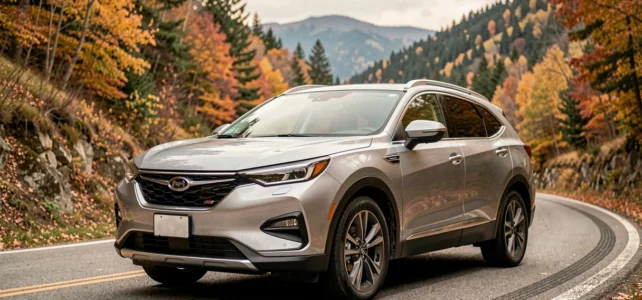
On a home-to-work journey that crosses a ZFE, choosing a non-rechargeable hybrid SUV is no longer just a matter of comfort or fuel consumption. It is primarily a question of access: will your vehicle still be able to circulate freely in two years? Recent full hybrid gasoline SUVs, classified as Crit’Air 1, remain authorized without restriction in the strictest metropolitan areas, including Paris and the Grand Paris. This is the first filter to apply before comparing models.
ZFE Access and Crit’Air Sticker: The Criterion That Comparisons Overlook
Most guides compare power, trunk volume, and combined fuel consumption. Rarely is time spent on regulatory issues, even though they condition the daily use of the vehicle for millions of drivers.
By 2026, Crit’Air 3, 4, and 5 vehicles will be heavily restricted in major French metropolitan areas. In Paris and the Grand Paris, Crit’Air 3, 4, 5, and unclassified vehicles are already banned on weekdays from 8 a.m. to 8 p.m. within the ZFE perimeter. As of January 1, 2027, the educational period ends, and penalties become systematic.
Only Crit’Air 0 and Crit’Air 1 vehicles can circulate without restriction in these zones. A recent full hybrid gasoline SUV falls into this category. A hybrid diesel, even recent, does not offer the same long-term access guarantee.
When looking for the best non-rechargeable hybrid SUV in 2026, this regulatory filter should come into play before any consideration of trim or engine type.
Toyota RAV4 Hybrid vs. Hyundai Tucson: Two Transmission Philosophies

These two models consistently appear in rankings, and for good reason. They are among the best-selling hybrid SUVs in France. However, their mechanical approach differs on one fundamental point: the management of the transmission.
The Toyota RAV4 Hybrid uses an epicyclic gear train (no traditional gearbox). The system continuously distributes power between the thermal engine and the electric motor. In practice, this results in a smooth driving experience, particularly suited for suburban journeys. The reliability of the Toyota hybrid system remains a benchmark in the segment, with several generations of experience.
The Hyundai Tucson Hybrid opts for a six-speed automatic transmission coupled with an integrated electric motor. The feel is closer to that of a traditional thermal vehicle, with shifting gears. The driving pleasure in dynamic driving is superior, but actual fuel consumption in the city rises slightly compared to the Toyota system.
What Driver Profile for Each Model
If your journeys are mostly urban or suburban (averaging less than 80 km/h), the RAV4 fully benefits from its electric mode at low speeds. On the highway, the hybrid advantage diminishes for both models: the thermal engine operates alone most of the time.
The Tucson Hybrid is better suited for those who alternate between departmental roads and expressways, where the gearbox offers better efficiency at stabilized speeds. Feedback on this point varies depending on driving style.
Kia Sportage Hybrid and Manufacturer Warranty: A Concrete Argument for Used Cars
The Kia Sportage Hybrid shares its platform and powertrain with the Tucson. The main difference lies in the manufacturer warranty: Kia offers a seven-year coverage, which radically changes the equation for a recent used purchase.
In the used car market, a two or three-year-old Sportage Hybrid still retains four to five years of warranty. This is a safety net that neither Toyota nor Hyundai offers in such proportions. For a non-rechargeable hybrid SUV purchased used, this extended coverage reduces the risk associated with the battery and hybrid system.
- Hybrid battery covered for the entire duration of the manufacturer warranty, at no extra cost
- Transmission and electrical components included, where other brands limit coverage to three or five years
- Resale value supported by this transferable warranty to the second owner
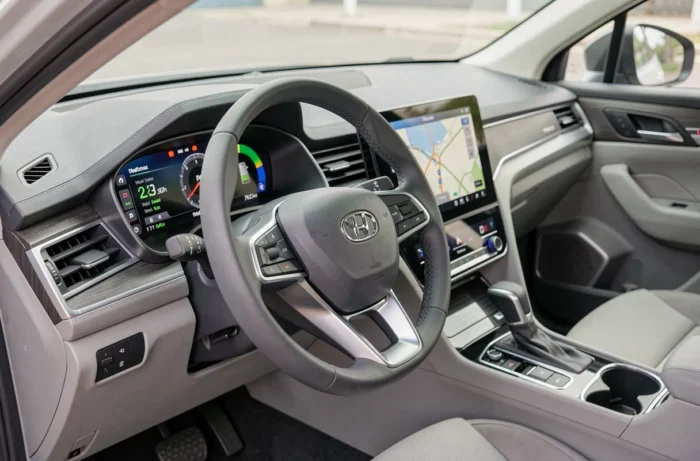
Real Consumption of Hybrid SUVs: What Changes Between the Technical Sheet and the Road
The WLTP figures announced by manufacturers measure consumption under standardized conditions. In real use, the gap can be significant, especially on the highway where the electric motor is less involved.
In the city, a full hybrid SUV consumes significantly less than an equivalent thermal vehicle. The electric motor takes over at traffic lights, in traffic jams, and during parking maneuvers. This is where the non-rechargeable hybrid system fully justifies its additional cost.
On expressways beyond 110 km/h, consumption approaches that of a conventional gasoline SUV. The actual gain depends on the percentage of urban driving in your daily journeys.
- Predominantly urban journeys: the consumption gain compared to a gasoline SUV is the most pronounced
- Mixed city-highway use: noticeable reduction, varying by model and driving style
- Long-distance highway: the hybrid advantage becomes marginal, the extra weight of the battery slightly weighs in
Peugeot 3008 and Renault Austral: The French Alternatives
The third-generation Peugeot 3008 and the Renault Austral both offer full hybrid powertrains. The 3008 focuses on a highly technological cabin and generous trunk space. The Austral plays the compromise card with adaptive suspension that improves comfort on degraded roads.
These two French models offer a competitive price-equipment ratio against their Korean and Japanese competitors. Their dense maintenance network across the territory also simplifies regular upkeep.
The choice of a non-rechargeable hybrid SUV in 2026 boils down to three concrete questions: does your vehicle pass the ZFE filter, are your journeys predominantly urban, and are you buying new or used? The answer to these three points automatically eliminates half of the models on the market.