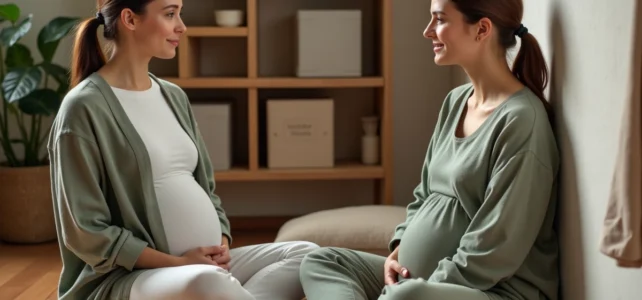
The profession of doula attracts more and more people each year who are looking to change careers or seeking perinatal support focused on listening. The question of the necessary training and diplomas arises quickly, and the answer often surprises: no state diploma is required to work as a doula in France. The profession is neither regulated nor recognized by an official body, which radically distinguishes it from perinatal health professions such as midwives or childcare assistants.
Doula and health profession: a clear regulatory boundary
The DREETS (Regional Directorates for Economy, Employment, Labor, and Solidarity) remind us that only regulated medical or paramedical professions require diploma recognition and authorization to practice. Non-medical support, such as that offered by a doula, does not fall within this framework.
This distinction has direct consequences on practice. A doula cannot access the rights of health professions: no employee status in maternity wards, no medical acts, no practice under a protected title. Only a person holding a state diploma (midwife, nurse, childcare assistant) can combine both roles by practicing under their medical title.
Those looking to understand how to become a doula in France often encounter this reality: training falls under the private sector, and legitimacy is built differently than through a state diploma.
The midwifery curriculum, for comparison, now leads to a doctorate in midwifery after six years of study. This level of training confers a health profession title that has no equivalent in a doula’s path. The two professions coexist, but on very different legal and practical levels.

Doula training in France: what private organizations offer
Since no official diploma governs the profession, the training offer relies entirely on private structures. Several centers offer in-person courses (Paris, Lyon, Bordeaux, Avignon, Toulouse, Rennes, La Réunion) or online, with varying durations and content.
Programs generally cover a common core:
- Physiology of pregnancy, childbirth, and postpartum, without claiming medical acts
- Active listening posture, emotional support for parents, and working on role boundaries
- Legal framework of the activity, independent status, relationship with health professionals
- Optional specializations: perinatal grief, end-of-life support (thanadoula), breastfeeding, perinatal massage
Some training sessions take place over a few weekends, while others span several months with practical internships. The duration of doula training varies from a few dozen hours to over two hundred hours depending on the organization and the chosen path (full or modular).
Qualiopi and RNCP certification: what these labels really guarantee
The Qualiopi label, mandatory since 2022 for training organizations wishing to access public funding (CPF, OPCO, Pôle emploi), certifies the quality of the educational process. It does not validate the specific content of doula training, nor does it confer state recognition of the profession.
Registration in the RNCP (National Directory of Professional Certifications) operates on the same principle: it attests to a level of skills, not to recognition of the doula profession. A training program registered in the RNCP has undergone an evaluation process of its educational objectives and results, which constitutes a guarantee of seriousness. Confusing this label with an official validation of the profession remains a common mistake.
Feedback from the field varies on this point. For some active doulas, Qualiopi or RNCP certification enhances credibility with families and funding for training. For others, the quality of support primarily depends on the content of the program and the experience of the trainers, regardless of the label.
Concrete criteria for evaluating a training program
In the absence of a national reference framework, a few benchmarks help distinguish structured paths from superficial offers:
- A sufficient hourly volume, including practical situations and field support (internships, mentoring)
- Clear teaching on the limits of the role: training must emphasize what a doula does not do (diagnosis, prescription, medical acts)
- The presence of trainers who have themselves worked as doulas or in the perinatal field
- An ethical charter or code of ethics associated with the training

Practicing without a state diploma: implications for the activity
The absence of regulation also means the absence of title protection. Anyone can present themselves as a doula, which both enriches and undermines the profession. Professional associations of doulas attempt to structure the profession through internal charters and directories of trained practitioners, but their membership remains voluntary.
In terms of status, the majority of doulas operate as micro-enterprises or sole proprietorships. The legal framework of the activity falls under personal services, with no diploma requirement. Setting up a structure is quick, but economic viability directly depends on the ability to develop a local clientele and diversify services (group workshops, postpartum support, additional training in perinatal well-being).
The current regulatory ambiguity does not mean that the situation is static. Discussions are ongoing about a more formal framework, particularly driven by doula associations seeking a national skills framework. The available data does not allow for conclusions about a timeline or the form that any potential official recognition would take. What remains clear: training, even private, constitutes the foundation of credibility for any doula wishing to establish themselves sustainably.