
You are returning from Spain with tobacco in the trunk and are wondering what the French customs really allow. The answer is less straightforward than a number of cartons displayed on a sign. Since 2024, the French legal framework has changed, and a decision by the Council of State at the end of 2025 has further blurred the lines. Here’s what you need to remember before crossing the border.
March 2024 Decree and Suspension by the Council of State: A Concrete Legal Ambiguity
For years, the rule seemed clear: one carton per person coming from a European Union country. Decree No. 2024-276 of March 27, 2024, removed this old ceiling. France then aligned itself with European logic, where personal use replaces the quantified quota.
At the end of December 2025, the Council of State suspended this decree, pending a substantive review scheduled for 2026. As a result, the text exists but is no longer fully applicable. Customs officers, however, continue to work with a well-known practical benchmark.
To understand the rules on cigarette cartons in Spain, you must accept this intermediate situation: no firm legal quota is in effect, but an indicative threshold guides daily checks.
Indicative Threshold of 800 Cigarettes: How Customs Applies It
The figure you will encounter everywhere is 800 cigarettes, or 4 cartons per person. This threshold is not an automatic right. It is a presumption: below this, customs officers generally consider that the tobacco is intended for your personal consumption.
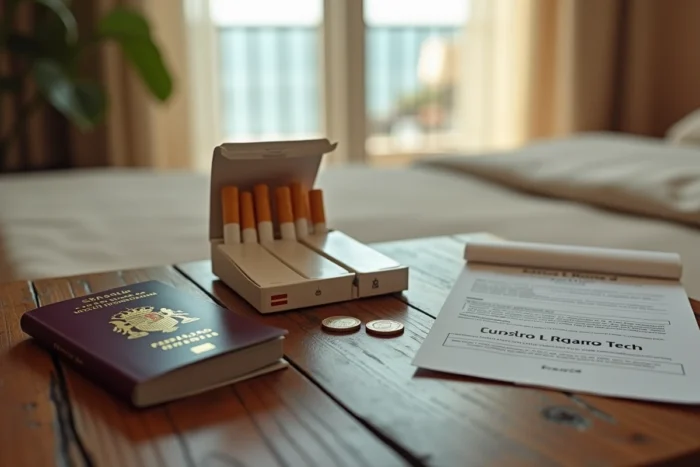
Above this threshold, the burden of proof shifts. The officer may determine that you are transporting tobacco for commercial purposes, even without any intention of resale on your part. The nuance is there: 4 cartons are not an acquired right but a practical benchmark.
In practical terms, a traveler returning with 3 cartons from Spain once a year will not be worried. The same traveler making the trip every week with 3 cartons will attract attention, even if they remain below the threshold.
What Customs Officers Really Check During a Tobacco Inspection
You might think that only the number of cartons matters. French customs officers actually look at a range of indicators. Here are the elements they consider to distinguish personal purchase from suspicion of trafficking:
- The frequency of cross-border trips: repeated crossings within a few days or weeks constitute a strong signal, even with small quantities each time
- The profile of the bearer and consistency with the quantities transported: a non-smoker carrying several cartons will need to justify the use
- The presence of receipts or proof of purchase: keeping your purchase receipts from Spanish tobacco shops facilitates verification and works in your favor
- The packaging of the tobacco: cartons still in cellophane, of different brands, in large quantities, may suggest an intention to resell
- Indicators of resale: online ads, message exchanges, disproportionately large cash amounts
This system of indicators means that an inspection never boils down to just counting the packets. Customs evaluates the overall situation.
Keeping Your Proof on Hand: An Underestimated Reflex
Many travelers throw away their receipt before crossing the border again. This is a mistake. In case of an inspection, a proof of purchase demonstrates the personal nature of the expense. Without proof, the officer can reclassify the transport as an infraction, even for two cartons.
Also keep your boarding pass or highway toll receipt. These documents attest to a one-time trip, not a regular route.
Customs Sanctions in Case of Exceeding or Suspected Resale
What do you risk if customs considers that your tobacco purchase exceeds personal use? The consequences are graduated but can become severe:
- Immediate confiscation of all tobacco products transported, not just the excess
- A customs fine whose amount depends on the quantity and value of the seized goods
- In case of recidivism or very large quantities, criminal prosecution for smuggling, with multiplied customs duties and penalties
The key point to remember: the confiscation applies to all tobacco, not just the surplus. You will not leave with your 4 “allowed” cartons if you were transporting 8.
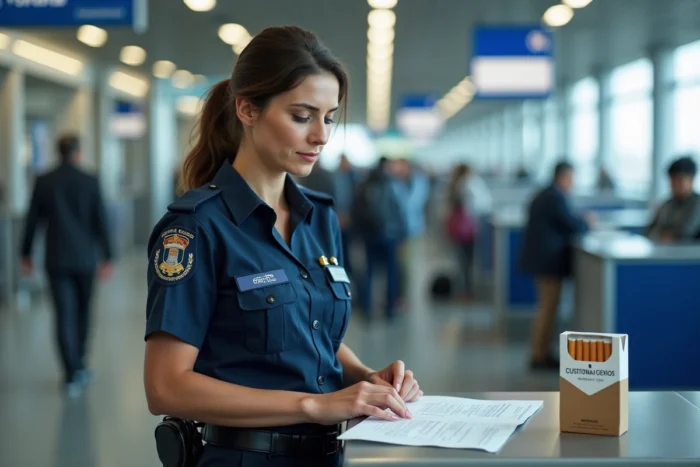
Difference Between Purchases in Spain and Purchases in Andorra or Outside the EU
Spain is part of the European Union. This detail changes everything. The indicative thresholds of 800 cigarettes apply only to returns from a member country of the EU.
If you pass through Andorra, which is not in the EU, the allowance drops to a significantly lower level. The same logic applies to duty-free purchases outside the European Union. Confusing the two situations is one of the most common mistakes at the Pyrenean border posts.
The price of tobacco in Spain remains significantly lower than in France, which motivates many cross-border trips. This price difference does not change customs obligations: the country of purchase determines the applicable regime, not the amount spent.
Rolling Tobacco and Other Tobacco Products
The European indicative thresholds do not only concern manufactured cigarettes. Rolling tobacco, cigars, and cigarillos have their own benchmarks. Thinking only in terms of “cartons of cigarettes” can lead to underestimating the total amount of tobacco transported, which customs adds up.
The legal situation remains fluid as long as the Council of State has not ruled on the 2024 decree. Until then, staying below the indicative threshold, traveling with your proof of purchase, and not multiplying trips remains the safest strategy for any smoker taking advantage of Spanish prices.