
A French vehicle fleet with an average age exceeding 11 years requires a radically different maintenance approach than that outlined in manufacturer service books. For mechanics that have surpassed a decade, the actual wear of components often exceeds the margins set by the original service intervals, and the bill rises: the average cost of a general service has significantly increased in recent years, driven by inflation in parts and labor.
Preventive maintenance on aging vehicles: underestimated areas
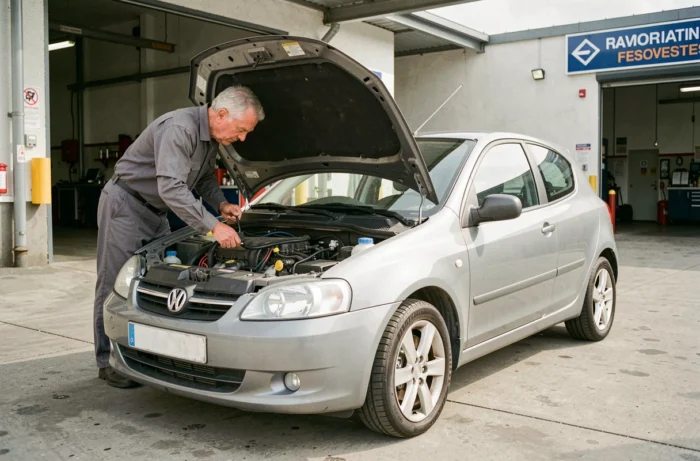
For a vehicle over eight years old, the manufacturer’s service book is no longer sufficient. The front suspension bushings, coolant hoses, and engine mounts deteriorate insidiously, without dashboard alerts. These rubber-metal parts do not always appear in standard service quotes, even though they are crucial for road handling and safety.
The braking system illustrates this gap well. Replacing the brake pads is a common reflex, but brake fluid absorbs moisture and loses its boiling point within two years. On an older vehicle, internal corrosion of the calipers adds to the problem. Braking that seems normal in the city can become dangerous on prolonged descents.
Detailed technical sheets by model and engine type are available on https://mon-guide-auto.fr/, allowing for targeted attention to specific vehicle concerns rather than following a generic protocol.
- Timing belt: on certain engines, the manufacturer’s interval exceeds the actual lifespan of the part beyond 10 years, regardless of mileage. An early replacement costs a few hundred euros, while a engine failure costs several thousand.
- Lambda sensor and catalytic converter: their gradual clogging increases consumption without triggering a check engine light on Euro 4 and earlier vehicles.
- Hydraulic clutch: the receiver leak manifests as a slowly evolving slipping point, easy to ignore until complete immobilization.

Cost of car repair: regional disparities and concrete levers
The price of the same operation varies by several dozen euros depending on the region. The 2026 barometers confirm that Île-de-France remains the most expensive area, with an acceleration in increases over the last measured year (nearly 9% increase in average repair costs).
This inflation does not affect all areas uniformly. Body parts and electronic components (ECUs, ADAS sensors) see the highest increases, driven by the complexity of recent vehicles. For an aging fleet, traditional mechanics remain more accessible, but the scarcity of certain spare parts for less common models drives up lead times and prices.
Maintenance outside the manufacturer network and warranty
Having a vehicle under warranty serviced at an independent garage is a right confirmed by European regulations, provided that the manufacturer’s recommendations are followed and invoices are kept. We recommend checking that the workshop uses parts of equivalent quality to the original and documents each intervention with the exact references.
A digital service book with time-stamped photos is now the best proof in case of a warranty dispute. Fleet management platforms already incorporate this traceability, and several independent garages offer this service to individuals.
Car insurance: deductible, policy, and pitfalls of compensation
The choice of an insurance policy is not limited to the choice between third-party or comprehensive coverage. For a vehicle whose market value decreases each year, comprehensive accident damage coverage becomes counterproductive when the deductible exceeds the annual depreciation. After a certain age threshold, switching to an extended third-party policy with theft and fire coverage offers a better coverage/cost ratio.
Several institutional reports have highlighted blind spots in the compensation practices of certain auto insurers. The most problematic areas concern the expert replacement value and the processing times for material claims. Checking the conditions for calculating the replacement value in the specific terms of the contract avoids surprises at the time of the claim.
Termination and Hamon law: what the new regulation changes
Since recent regulatory adjustments, annual termination after the first year of the contract is a real negotiation lever. We observe that insurers adjust their renewal rates based on the observed cancellation rate in their portfolio. An insured person who indicates their intention to cancel regularly receives a more competitive counter-offer than the initial renewal rate.
- Compare deductibles by type of claim (glass breakage, theft, natural disaster) rather than just the annual premium amount.
- Check if the contract includes a new-for-old clause, and for how long it applies.
- Control the compensation cap for the contents of the vehicle, often limited to a few hundred euros in standard policies.
Car purchase: technical criteria before the displayed price
The total cost of ownership (TCO) of a vehicle includes insurance, maintenance, depreciation, and fuel consumption. A vehicle cheaper to purchase may cost significantly more over five years if its engine requires short maintenance intervals or expensive parts.
In the used car market, the availability of spare parts and documented maintenance history weigh more heavily than gross mileage. A vehicle with 150,000 km and rigorous follow-up and complete invoices presents a lower mechanical risk than one listed at 90,000 km without any justification.
The condition of the tires at the time of purchase provides a reliable indicator of the care given to the vehicle. Tires of different brands on the same axle, asymmetric wear, or cracked sidewalls signal neglected maintenance, far beyond the simple issue of replacing tires.
The continuous increase in the average age of the fleet and the inflation of maintenance costs make each technical decision more critical than it was ten years ago. Documenting each intervention, adapting insurance coverage to the actual value of the vehicle, and anticipating replacements of critical parts before failure effectively limit unexpected expenses and reduce the risk of immobilization.