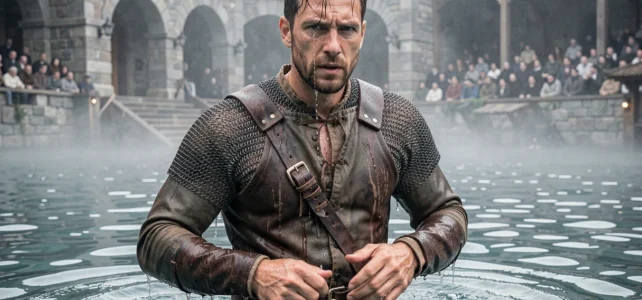
When a Viking drakkar breaks the surface of a lake or a wedding carriage emerges from the depths during the Weddings of Fire, the audience holds its breath. Behind these spectacular appearances, there are submerged actors, sometimes for several minutes, who must breathe, see, and play their role in opaque water. Puy du Fou has developed specific technical protocols to make these scenes possible, far from mere magic tricks.
Breathing underwater at Puy du Fou: what the scenic pools conceal
The first problem to solve is not artistic; it is physiological. An actor submerged in a scenic pool cannot simply hold their breath while waiting for their cue. The immersion sequences last too long for simple apnea, and the daily repetition of the shows prohibits taking that risk.
The solution relies on compressed air supply systems hidden beneath the surface. Mouthpieces connected to pressurized air circuits are positioned at precise points in the pool. Actors connect to them between visible playing phases, breathe normally, and then release the mouthpiece at the exact moment of their emergence. To understand how the actors emerge from the water at Puy du Fou, one must imagine a network of invisible breathing stations, timed to the show’s schedule.
The pools themselves are not just simple natural bodies of water. They are technical pools with controlled depth, featuring a concrete or resin bottom, tactile markers for actors to position themselves in the dark, and a filtration system that maintains water quality compatible with prolonged contact on skin and eyes.
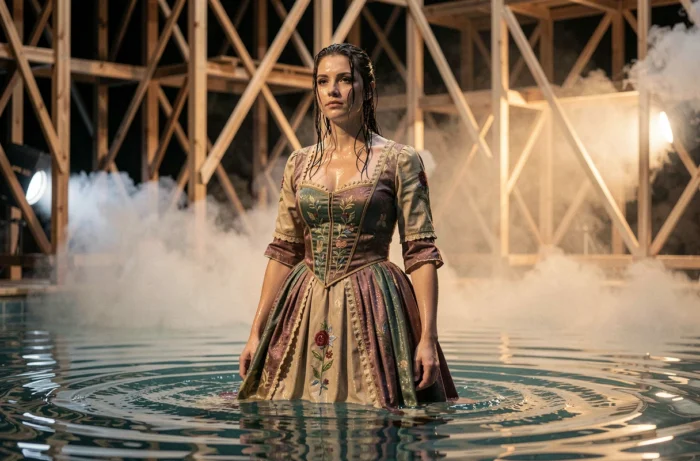
Hydraulic machinery of the lake shows
Making an actor emerge alone is one thing. Making a multi-ton set rise with actors on board is another. The show Weddings of Fire illustrates this complexity: two submerged structures, one carrying a piano and the other a wedding carriage pulled by swans, must rise from the bottom of the lake with actors onboard.
This type of machinery relies on hydraulic cylinders controlled by programmable automata. SDEI Spectacles, a specialist in scenographic machinery, collaborated with Hynoxelis (electro-hydraulic engineering) and EAS’HY (manufacturer of hydraulic systems) to integrate Poclain Hydraulics motors and pumps into the whole. The result: platforms capable of moving vertically with enough precision for the actors to remain stable and safe throughout the emergence phase.
Synchronization between machines and actors
The most delicate constraint is timing. The structures rise at a calibrated speed, neither too fast (risk of imbalance) nor too slow (the dramatic effect collapses). The onboard actors must adopt their stage posture before the audience sees them, as the emergence lasts barely a few seconds.
This involves coordination between a technical manager who triggers the hydraulic sequence, an artistic director who supervises the overall rhythm, and the actors who mentally count the seconds to align their performance with the mechanical rise. No delay can be compensated: if the platform emerges a second early, the actor must be ready.
Aquatic safety and regulatory framework at Puy du Fou
Working submerged in a scenic pool is not merely entertainment. Safety obligations are similar to those applied to diving centers and public swimming pools, with some specificities unique to amusement parks.
- Aquatic show areas must be clearly delineated from spaces accessible to the public, to avoid any confusion with a swimming area.
- Safety divers are stationed offstage, ready to intervene at each performance. Their role: monitor the submerged actors in real-time and react in case of technical problems (faulty air mouthpiece, mechanical blockage).
- A decree from July 29, 2026, established a validation system for the experience acquired for the aquatic rescue trainer competency certificate, facilitating the internal training of qualified personnel in parks with scenic pools.
- Large parks with pools are increasingly encouraged to adopt surveillance standards comparable to those of swimming pools, according to recent regulatory discussions on amusement water parks.
Documenting prevention protocols has become a significant issue. The technical water bodies where ships or actors emerge must incorporate measures against visitor intrusions, to prevent reckless behaviors from being mistaken for unregulated swimming.
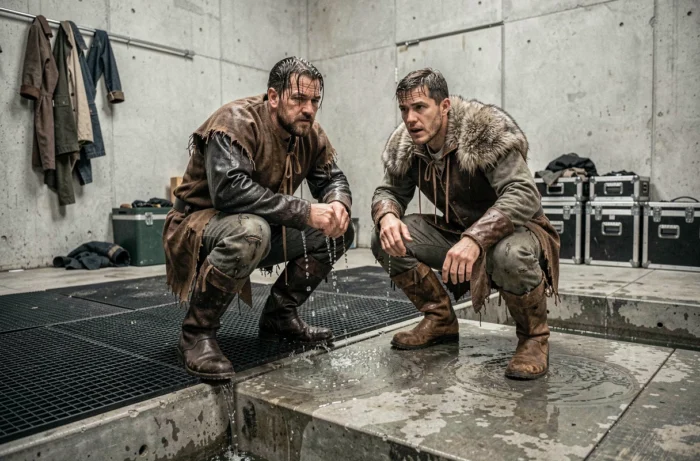
Training Puy du Fou actors for aquatic scenes
Not just any actor is entrusted with an immersion role. Selection involves a physical assessment that goes beyond a simple swimming test. It is necessary to check comfort in dark aquatic environments, the ability to remain calm in a confined space under a mobile structure, and the capacity to perform multiple shows without excessive fatigue.
Pool rehearsals begin well before the season. Actors learn to locate breathing points by touch, manage pressure on their eardrums during immersion phases, and synchronize their movements with the rise of the hydraulic platforms. Each aquatic scene undergoes dozens of technical rehearsals before the first public performance.
Feedback varies on this point, but several testimonies from former volunteers at Puy du Fou mention a gradual accompaniment: starting with short immersions in simplified conditions, then increasing the duration and complexity until reaching the actual show conditions.
Daily physical constraints
Performing in cold water several times a day throughout the season requires serious physical conditioning. The suits worn under historical costumes limit thermal loss but do not eliminate it. Managing muscle fatigue related to cold and repeated immersions is an integral part of the preparation.
Puy du Fou mobilizes a set of skills for these aquatic shows that far exceeds the scope of classical theater. Hydraulic engineering, aquatic safety, physical training of actors: each spectacular emergence relies on an invisible mechanism as precise as the staging itself.