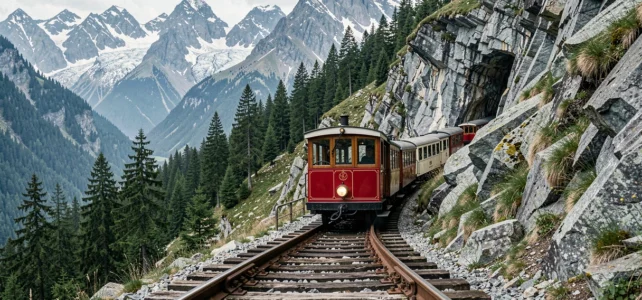
We arrive at the Montenvers train station wearing city sneakers and carrying a four-year-old in our arms. Twenty minutes later, the cogwheel train drops us off at an altitude of 1,913 meters, facing a landscape that no longer resembles the photos in paper guides. The Mer de Glace has changed, and so has the visit. Here is our updated field report to know what to expect before heading up.
What the glacier’s retreat changes for the visit in 2025
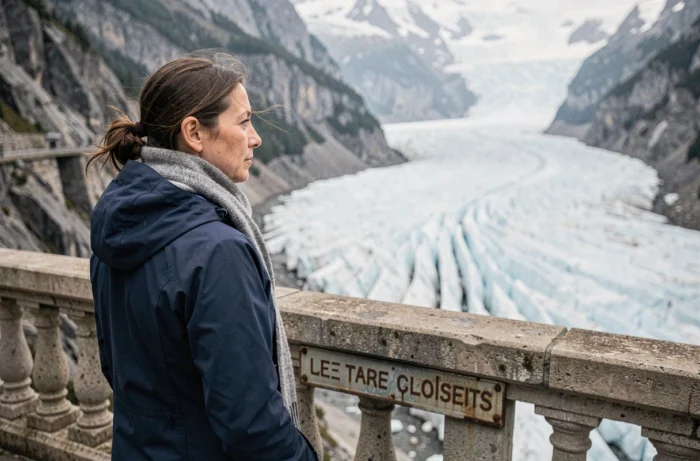
The point that most traveler feedback does not detail is the physical impact of glacial retreat on the route. The Mer de Glace has lost about 220 meters of thickness at the Montenvers level, around a hundred of which have been lost in the last thirty years. Its area fell below 30 km² by the end of 2024.
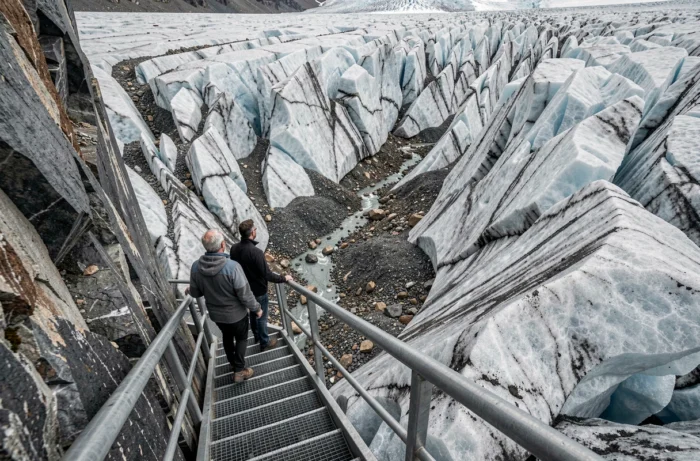
In practical terms, this means that the distance between the arrival station and the glacier’s surface increases each year. The steps to descend to the ice cave are numerous (about 170 steps according to the official site). The cable car connecting Montenvers to the glacier level has been adapted, but the journey remains physically demanding, especially on the return uphill.
For us, publishing a review of the Mer de Glace and the Montenvers train without mentioning this reality would be incomplete. The glacier is melting quickly, and the site is constantly adapting. The signs on-site indicate the glacier’s levels at different times, providing a striking visual scale of the melting.
Montenvers train with children: practical constraints in Chamonix
The cogwheel train departs from Chamonix center, which simplifies logistics. The ascent takes about twenty minutes in a panoramic car where children are generally captivated by the tunnels and viaducts. No reported motion sickness, the pace is slow.
However, the complete visit requires two to three hours including travel and the cave. This is long for younger ones. The 170 steps to the ice cave pose a real problem with a stroller (it stays at the top). With a baby carrier, it works, but the knees do get a workout.
- Wear closed shoes, even in summer: the areas around the glacier are damp and the steps slippery in places
- Bring an extra layer of clothing, as the temperature drops significantly inside the cave
- The on-site dining options (restaurant at the Refuge du Montenvers, Le Panoramique, Bar des Glaciers) allow you to split the visit into two parts if the child gets tired
For families with young children, one can very well enjoy the panorama from Montenvers and the Glaciorium without descending to the cave. The experience remains worthwhile.
Ice cave and Glaciorium: what is worth the detour
The ice cave is reshaped each year in the glacier. You walk through a bluish tunnel, with sculptures and themed rooms. The visual effect is real, especially for a first visit. Feedback varies on this point: some visitors find the cave smaller than expected, while others are struck by the light and colors.
The Glaciorium is the most underrated space on the site. This interactive area dedicated to glaciology explains the formation of glaciers, their dynamics, and their retreat. For children aged six or seven and up, it is well designed. The models and touch screens make the subject accessible without oversimplifying.
Between the cave and the Glaciorium, you can easily spend an extra hour more than planned. This is the part of the visit that justifies the overall price, more than the train ride alone.
Prices, schedules, and crowds: planning your ascent to Montenvers
Prices vary by category (adult, child, senior, family). The official site of the Mont-Blanc Natural Resort publishes updated price lists, with packages that include the train and the cave. Buying your ticket online avoids the line at the Chamonix station, especially in July-August and during school holidays.
Regarding schedules, the first train departs early in the morning. It is recommended to aim for this time slot for two reasons:
- The midday crowd turns the descent to the cave into a waiting line, especially when several trains arrive at the same time
- The morning light on the glacier and the Drus offers a clearer panorama than in early afternoon when the heat haze rises
- Returning in early afternoon frees up the rest of the day for Chamonix or another activity in the valley
One point of caution: social movements have occasionally disrupted train service in recent years. Checking the day before on the official site or by phone remains a reasonable precaution, especially if you have organized the day around this visit.
Retreating glacier, evolving visit: is it still worth going
The Mer de Glace is no longer the frozen spectacle of postcards. The glacier is retreating, thinning, and the site is continuously adapting. It is precisely this transformation that makes the visit relevant today. The historical reference panels, the Glaciorium, and the bird’s-eye view of a changing glacier provide a concrete reading of climate change.
For a family, the Montenvers train remains a complete and accessible outing from Chamonix. For adults alone, the hike back on foot (Montenvers trail) adds a sporting dimension that the train alone does not provide. In both cases, it is better to go knowing that today’s landscape will not be the same in five years. This is also what makes this ascent to the glacier hard to postpone.