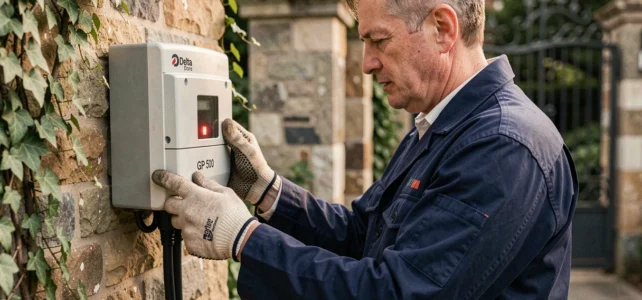
The Delta Dore GP 500 manages power distribution by temporarily cutting off non-priority circuits (heating, water heater) when consumption approaches the subscription limit. A red light on this load shedding device does not indicate a normal load shedding in progress: it signals a fault in the measurement or control chain, which directs the diagnosis towards specific issues.
HP/HC control signal and interaction with the Linky meter
The majority of persistent red lights documented on technical forums appear in installations where the dry contact for off-peak/peak hours is involved. The GP 500 receives tariff switching information from the meter, and it is this information that triggers or releases the control of the water heater.
When the Linky meter replaces an old electromechanical meter, the output contact changes in nature. The old normally closed contact is replaced by a dry contact integrated into the Linky, whose electrical behavior differs. If the wiring between the C1/C2 output of the Linky and the input of the load shedding device is not suitable, the GP 500 interprets the absence of signal as an anomaly and goes into fault mode.
We regularly observe cases where replacing the day/night contactor does not resolve anything because the problem lies upstream, on the meter-load shedding device link. A continuity check with an ohmmeter of the dry contact in the closed position (active off-peak hours) allows validation or exclusion of this issue in a few seconds.
To delve deeper into the operation of the Delta Dore GP 500 and its safety implications, diagnosing the control chain remains the most reliable starting point.
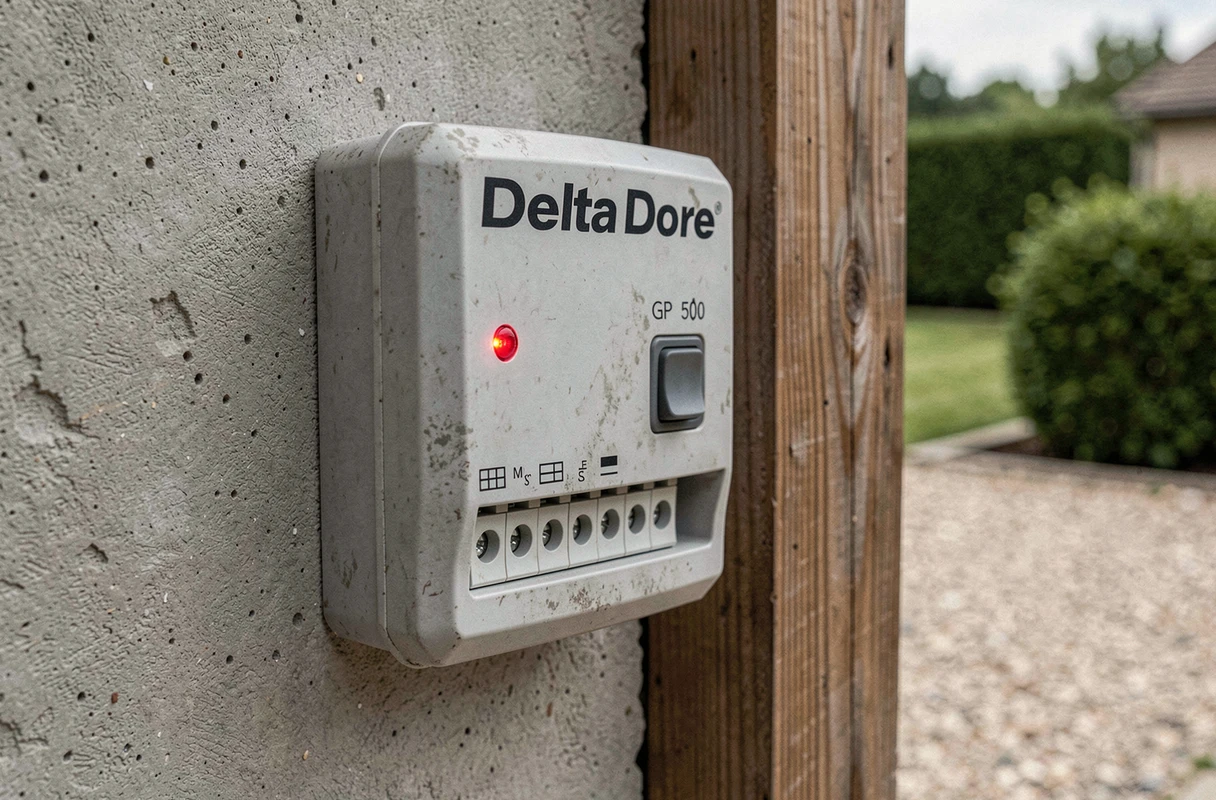
Fixed or flashing red light on the GP 500: two distinct diagnostics
Not all red lights are the same. The behavior of the light, whether fixed or flashing, points to different causes. Confusing the two leads to unnecessary interventions.
Fixed red light
A fixed red light generally indicates a security lock of the module. The load shedding device has detected an abnormal condition (loss of communication, prolonged overload, voltage fault on an output path) and blocks the control of the affected circuits. The water heater remains continuously off, even during off-peak hours.
Resetting by cutting power at the circuit breaker, then restoring power after about thirty seconds, is sometimes enough to clear the fault if the cause was transient. If the red light comes back immediately, the fault is structural.
Flashing red light
A flashing light often indicates a communication fault between the load shedding device and its receivers. In installations where pilot wire receivers or radio modules are associated with the GP 500, a loss of association or radio interference triggers this flashing.
We recommend checking:
- The status of associations between the GP 500 and each receiver (reassociation procedure described in the Delta Dore manual)
- The distance and obstacles between the load shedding device and the radio receivers, a concrete floor or a metal panel may suffice to cut the range
- The presence of interference on the frequency band used by the modules (other home automation equipment, nearby Wi-Fi repeaters)
Power supply voltage fault of the GP 500
A rarely isolated point in consumer guides: the GP 500 itself can be powered in an unstable manner. Insufficient tightening on the power terminal, a poorly connected neutral wire, or an aging protective circuit breaker can cause micro-cuts that the load shedding device interprets as anomalies.
A voltage check at the terminals of the module under load can detect an abnormal voltage drop. In a correct installation, the measured voltage should not deviate significantly from the nominal voltage of the network.
This type of fault often manifests intermittently: the red light appears at the end of the day when the load on the domestic network is at its highest, then disappears at night. The trap is to believe that the problem resolves itself, while the poor contact degrades gradually.

Replacement or repair of the GP 500 load shedding device
The GP 500 has not been manufactured for several years. Delta Dore has evolved its range towards energy managers compatible with the Tydom ecosystem. Finding a new replacement GP 500 falls into the second-hand market or residual stock.
Before replacing the module, it is essential to ensure that the fault indeed comes from the load shedding device and not from its environment. We have listed the preliminary checks:
- Measure the continuity of the dry contact from the meter to the GP 500
- Check the tightening of each terminal of the load shedding device to the recommended torque
- Test each output path independently by manually forcing the load shedding
- Check the condition of the day/night contactor downstream, which may be the real source of the fault
If all these checks are conclusive and the red light persists, replacing the GP 500 with a recent energy manager becomes the solution. A qualified electrician will adapt the existing wiring to the new module, especially if the installation shifts from wired control to radio control.
The red light of the GP 500 remains primarily a diagnostic indicator. Precisely identifying its behavior (fixed, flashing, intermittent) and tracing the control chain from the meter to the receivers helps avoid premature replacement of the module when the fault lies elsewhere in the panel.