A glass that falls on the pool deck shatters into dozens of fragments, and some ends up in the pool. This scene occurs more often than one might think, especially since poolside areas favor mineral terraces and hard stone coverings. On these surfaces, a tipped glass does not bounce: it breaks cleanly, and the shards slide into the water within seconds.
The problem is not just aesthetic. A shard just a few millimeters long is enough to injure a bare foot or damage a liner. And once in the water, the glass becomes nearly invisible.
Why glass shards end up in the pool
The first cause is simple: real dishes are used at the poolside. Current trends lean towards mineral beaches, tiled terraces, and Bali stone coping. These arrangements make the space more elegant, but they create a hard surface where even the slightest impact breaks the glass. On composite wood or grass, a fallen glass may chip or remain intact. On porcelain stoneware, it explodes.
The second frequent source: glass walls and railings installed around the pool. A poorly secured panel, repeated thermal shock, or impact from a heavy object can cause it to shatter. Tempered glass fragments into smaller pieces that are less sharp than ordinary glass, but these fragments scatter in the water and on the deck.
The third case, less obvious: the filtering glass used in the sand filter tank. This filtering medium, made of recycled glass granules, can rise into the pool if the filter’s strainer is cracked or if backwashing is poorly executed. Small polished glass beads can then be found at the bottom of the pool, often mistaken for sand.
To better understand the causes and solutions for glass in the pool, it is essential to distinguish these three origins before taking action.
Removing glass from the bottom of the pool without worsening the situation
The first reflex, using the robot, is often the worst. A pool robot is not designed to vacuum glass shards. The fragments can puncture the filter bag, scratch the rotating brushes, or get stuck in the mechanism. On a liner, the robot may also drag the shards and create micro-cuts in the lining.
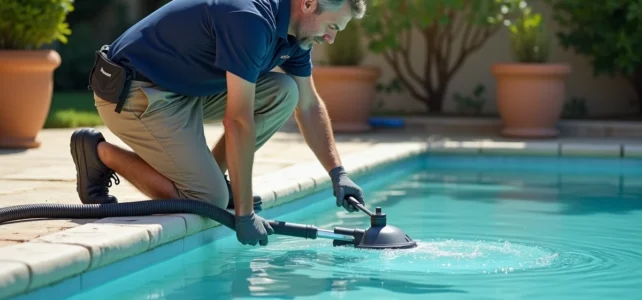
The effective method relies on manual vacuuming. Connect a vacuum head to the vacuum inlet or skimmer, set the filter multiport valve to “drain” (or “waste”), and slowly vacuum the bottom of the pool. The water laden with debris goes directly to the drain without passing through the filter. This is the only way to prevent the shards from damaging the filtering medium in the tank.
Steps to follow in order
- Turn off the pump and wait for the particles to settle at the bottom. A delay of one to two hours allows the finest fragments to sink.
- Set the valve to “drain” before restarting the pump, then vacuum in slow and steady passes without stirring up turbulence.
- Inspect the liner or covering after vacuuming, running a (gloved) hand over suspicious areas to detect any embedded shards.
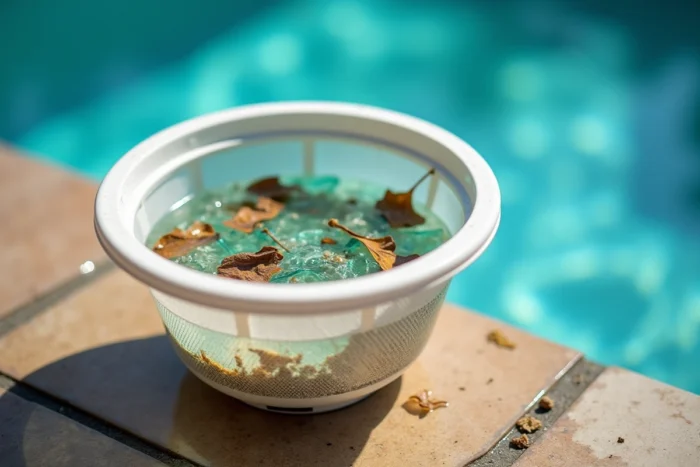
- Check the skimmer basket and the pump pre-filter, where pieces may have lodged before switching to drain mode.
This operation lowers the water level in the pool. A water top-up should be planned afterward, followed by an adjustment of the treatment.
Filtering glass rising into the pool: filter diagnosis
When glass granules are found at the bottom of the pool without any breakage occurring, the problem almost always comes from the strainer or the filter collectors. These plastic parts, located at the bottom of the tank, retain the filtering medium while allowing filtered water to pass through. A crack, even a fine one, can release glass particles into the return circuit.
Several reports from owners indicate that the water turns green despite using filtering glass. The glass is not the issue: it is the sizing of the pump or the state of the filtration that is problematic. A filter with a damaged strainer no longer filters, regardless of the medium used.
To check, the filter tank must be opened, the filtering glass removed, and each strainer inspected by hand. A broken strainer is easy to replace, but the part is rarely found alone in stores: it often requires ordering the complete set. Reports vary on this point depending on filter brands, with some offering strainers individually.
Preventing broken glass around the pool
The most effective prevention comes down to one rule: prohibit glass dishes on the pool deck. Tritan or polycarbonate cups withstand drops on stone without breaking. For poolside snacks, they replace stemware without compromising on usability.
Regarding glass railings and fences, choosing laminated glass (like Stadip) rather than simple tempered glass limits the dispersion of shards in case of breakage. Laminated glass cracks but stays in place thanks to its plastic interlayer, preventing the projection of fragments into the water.
- Replace all poolside glassware with unbreakable containers.
- Check the fixings of glass panels at least once per season, particularly the clamps and base seals.
- Install a removable safety net during work or renovation of the terrace to prevent debris from falling into the pool.
Glass in a pool remains an isolated incident, but its consequences last if one reacts poorly. Vacuuming in drain mode, never sending shards into the filter, and especially banning fragile glasses from the poolside: these three reflexes are enough to solve the problem before it damages the liner or filtration.